ANALYSIS OF EMISSION CHARACTERISTICS OF A B35 WITH HYDROGEN PEROXIDE EMULSION WITHOUT SURFACTANTS
Abstract
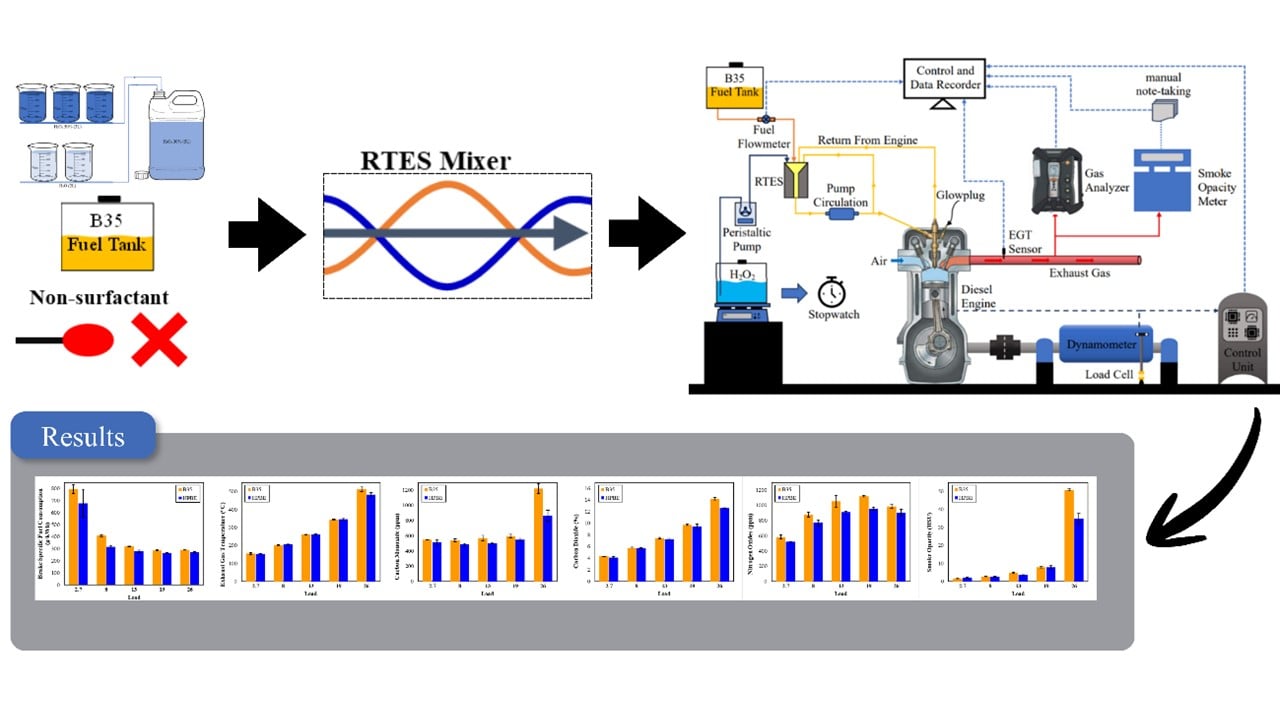
The use of hydrogen peroxide or H2O2 as a fuel additive is known to improve the combustion quality of conventional fuels, including Indonesia’s biodiesel B35. Because H2O2 and B35 do not mix naturally, the H2O2 must be emulsified into B35 to ensure stable fuel delivery and consistent combustion. Conventional emulsification methods typically rely on chemical surfactants, which require a separate preparation step. This study therefore aimed to evaluate the effects of an H2O2–B35 emulsion (HPBE) produced without surfactants on diesel engine performance and emissions. The emulsion was prepared using B35 as the base fuel and 10% (v/v) of 30% aqueous H2O2 as the dispersed phase. Emulsification was carried out using an inline mixer known as the Real-Time Non-Surfactant Emulsion Fuel Supply System (RTES). Engine tests were performed on a Kubota Z482 operating at a constant speed of 2800 rpm under loads of 2.7, 8, 13, 19, and 26 Nm, applied using a Cussons eddy current dynamometer. The parameters measured include Brake Specific Fuel Consumption (BSFC), exhaust gas temperature (EGT) as well as Carbon Monoxide (CO), Carbon Dioxide (CO2), Nitrogen Oxide (NOx) emissions, and smoke opacity. The results showed that, compared to B35, HPBE improved all measured parameters across all loads. BSFC decreased, with the maximum reduction of 22.9% occurring at 8 Nm. At full load, HPBE produced the maximum reductions in smoke opacity (31.3%), CO (29.5%), and CO2 (11.2%). Meanwhile, the maximum NOx reduction of 14.3% was observed at 75% load.
Downloads
References
Y. M. Oo, J. Thawornprasert, N. Intaprom, K. Rodniem, and K. Somnuk, “Diesel–Biodiesel–Water Fuel Nanoemulsions for Direct Injection and Indirect Injection Diesel Engines: Performance and Emission Characteristics,” ACS Omega, vol. 7, no. 39, pp. 34951–34965, Oct. 2022, doi: 10.1021/ACSOMEGA.2C03553.
N. Ahmad, K. Khaerudin, J. Jupriyanto, A. Haryanto, and R. D. Putra, “Contribution of B35 Biodiesel to Indonesia’s Renewable Energy Target and Challenges for B40 Implementation,” MOTIVECTION : Journal of Mechanical, Electrical and Industrial Engineering, vol. 7, no. 3, pp. 291–302, Sep. 2025, doi: 10.46574/MOTIVECTION.V7I3.473.
N. I. Bahtera, M. Khaliqi, and N. Novindra, “The Impact of Crude Palm Oil Downstreaming Policies on the Indonesian Palm Oil Industry,” BIO Web Conf., vol. 208, p. 04001, 2026, doi: 10.1051/bioconf/202620804001.
O. Litvak and S. Litvak, “Some Aspects of Reducing Greenhouse Gas Emissions by Using Biofuels,” Journal of Ecological Engineering, vol. 21, no. 8, pp. 198–206, Nov. 2020, doi: 10.12911/22998993/126967.
M. Zandie, H. K. Ng, S. Gan, M. F. M. Said, and X. Cheng, “The viability of using gasoline-integrated biodiesel–diesel mixtures in engines as a solution to greenhouse gas emissions: a review,” Clean Energy, vol. 6, no. 6, pp. 848–868, Dec. 2022, doi: 10.1093/ce/zkac056.
Q. F. Erahman, N. Reyseliani, W. W. Purwanto, and M. Sudibandriyo, “Modeling Future Energy Demand and CO2 Emissions of Passenger Cars in Indonesia at the Provincial Level,” Energies 2019, Vol. 12, vol. 12, no. 16, Aug. 2019, doi: 10.3390/en12163168.
A. Mandal, D. Cha, and H. M. Cho, “Impact of Waste Fry Biofuel on Diesel Engine Performance and Emissions,” Energies 2023, Vol. 16, Page 3711, vol. 16, no. 9, p. 3711, Apr. 2023, doi: 10.3390/EN16093711.
I. S. A. Manaf et al., “A review for key challenges of the development of biodiesel industry,” Energy Convers. Manag., vol. 185, pp. 508–517, Apr. 2019, doi: 10.1016/j.enconman.2019.02.019.
A. A. Babadi et al., “Emerging technologies for biodiesel production: Processes, challenges, and opportunities,” Biomass Bioenergy, vol. 163, Aug. 2022, doi: 10.1016/j.biombioe.2022.106521.
S. K. Bhatia et al., “Wastewater based microalgal biorefinery for bioenergy production: Progress and challenges,” Science of the Total Environment, vol. 751, Jan. 2021, doi: 10.1016/j.scitotenv.2020.141599.
D. Perdana and F. S. Putra, “Perilaku Api dan Emisi pada Pembakaran Droplet Biodiesel Dicampur Diethyl Ether yang Dipengaruhi Medan Magnet,” Scientific Journal of Mechanical Engineering Kinematika, vol. 10, no. 1, pp. 81–90, Apr. 2025, doi: 10.20527/sjmekinematika.v10i1.329.
K. R. R. Chebattina et al., “H2O2 as fuel additive in bio-diesel for emission reduction and performance enhancement of variable compression ratio (VCR) diesel engine,” Mater. Today Proc., vol. 47, pp. 5697–5700, Jan. 2021, doi: 10.1016/J.MATPR.2021.04.141.
M. B. Sanjeevannavar et al., “Machine Learning Prediction and Optimization of Performance and Emissions Characteristics of IC Engine,” Sustainability 2023, Vol. 15, Page 13825, vol. 15, no. 18, p. 13825, Sep. 2023, doi: 10.3390/SU151813825.
A. K. Subramani, G. Duraisamy, N. Govindan, and A. K. Hossain, “An innovative method of ammonia use in a light-duty automotive diesel engine to enhance diesel combustion, performance, and emissions,” Int. J. Hydrogen Energy, vol. 49, pp. 38–58, Jan. 2024, doi: 10.1016/J.IJHYDENE.2023.06.183.
S. Vellaiyan, “Enhancing energy and environmental metrics of aqueous ammonia emulsified diesel fuel using carbon-metal oxide nanocomposites: An experimental study,” Case Studies in Thermal Engineering, vol. 59, p. 104569, Jul. 2024, doi: 10.1016/J.CSITE.2024.104569.
I. A. Moujdin, M. S. Khan, H. A. Abulkhair, A. A. Shaiban, H. A. Organji, and A. O. Alsaiari, “Influence of hydrogenated diesel/H2O2 blend fuel on diesel engine performance and exhaust emission characterization,” Sci. Rep., vol. 13, no. 1, pp. 1–14, Dec. 2023, doi: 10.1038/S41598-023-27569-5;SUBJMETA.
S. Mohan and P. Dinesha, “Emulsification of waste cooking oil biodiesel blend with hydrogen peroxide to assess tailpipe emissions and performance of a compression ignition engine,” Heat Transfer, vol. 51, no. 4, pp. 3721–3735, Jun. 2022, doi: 10.1002/HTJ.22518.
S. Oh, C. Park, M. Ahn, H. J. Jang, and S. Kim, “Experimental approach for reducing nitrogen oxides emissions from ammonia–natural gas dual-fuel spark-ignition engine,” Fuel, vol. 332, p. 126065, Jan. 2023, doi: 10.1016/J.FUEL.2022.126065.
W. N. I. B. W. Mahdi, A. M. Bin Ithnin, W. J. Bin Yahya, M. A. B. A. Rashid, and H. B. A. Kadir, “The effect of different in-line mixing method of water-in-diesel emulsion fuel on the diesel engine performance,” AIP Conf. Proc., vol. 2582, no. 1, Aug. 2023, doi: 10.1063/5.0128959.
N. A. Ramlan et al., “Emissions and performance analysis of diesel powered road vehicle equipped with real-time non-surfactant emulsion fuel supply system,” Fuel, vol. 273, p. 117257, Aug. 2020, doi: 10.1016/j.fuel.2020.117257.
H. Abdul Rahman, N. A. Ramlan, W. J. Yahya, and M. Q. Mohd Tamam, “A comparative analysis of mixing methods for real time emulsion fuel supply systems for common-rail fuel injection diesel engine,” Fuel, vol. 381, p. 133469, Feb. 2025, doi: 10.1016/J.FUEL.2024.133469.
M. F. Al-Dawody et al., “Mechanical engineering advantages of a dual fuel diesel engine powered by diesel and aqueous ammonia blends,” Fuel, vol. 346, p. 128398, Aug. 2023, doi: 10.1016/J.FUEL.2023.128398.
Q. Ma, J. Wang, S. Jin, and M. Shi, “The impact of ignition and activation energy distribution on the combustion and emission characteristics of diesel-ammonia-natural gas engines,” Journal of the Energy Institute, vol. 118, p. 101903, Feb. 2025, doi: 10.1016/J.JOEI.2024.101903.
F. R. Saputro et al., “Effects of oxyhydrogen enrichment on diesel engine performance and emissions using B35 and its water-in-biodiesel emulsion,” Int. J. Hydrogen Energy, vol. 142, pp. 109–121, Jun. 2025, doi: 10.1016/J.IJHYDENE.2025.05.359.
M. B. Sanjeevannavar et al., “Performance indicators for the optimal BTE of biodiesels with additives through engine testing by the Taguchi approach,” Chemosphere, vol. 288, p. 132450, Feb. 2022, doi: 10.1016/J.CHEMOSPHERE.2021.132450.
X. Zhang et al., “Assessment of hydrogen and nanoparticles blended biodiesel on the diesel engine performance and emission characteristics,” Fuel, vol. 307, p. 121780, Jan. 2022, doi: 10.1016/J.FUEL.2021.121780.
M. Elkelawy, A. M. Draz, H. E. Seleem, and M. A. Hamouda, “Performance Characteristics of Diesel Engine Power Plants: Efficiency, Emissions, and Operational Flexibility,” Pharos Engineering Science Journal, vol. 2, no. 1, pp. 1–11, Mar. 2025, doi: 10.21608/PESJ.2025.352971.1009.
Copyright (c) 2026 Agus Mulyana, Muhammad Fariedz Irawan, Fakhrul Afif Uzair, Dhani Avianto Sugeng , Kurnia Fajar Adhi Sukra, Frendy Rian Saputro, Wira Jazair Yahya, Rizqon Fajar, Boni Sena, Ujiburrahman

This work is licensed under a Creative Commons Attribution-NonCommercial-ShareAlike 4.0 International License.