MOLECULAR ADSORPTION OF ZEA MAYS LEAF PHYTOCHEMICALS ON Fe(110) AS CORROSION INHIBITORS: DFT AND MONTE CARLO STUDY
Abstract
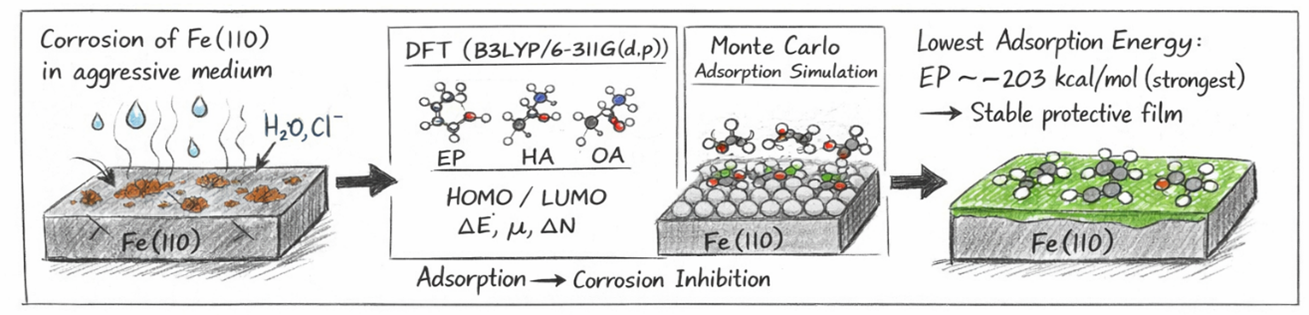
Plant-derived compounds have attracted increasing attention as environmentally friendly corrosion inhibitor candidates. However, the molecular adsorption behavior of selected phytochemicals from Zea mays leaves on iron surfaces remains insufficiently understood. This study investigates ethyl palmitate (EP), hexadecanoic acid (HA), and 9,12,15-octadecatrienoic acid (OA), identified from Zea mays leaf extract, as potential inhibitors for the Fe(110) surface. Density Functional Theory (DFT) calculations at the B3LYP/6–311G(d,p) level were used to evaluate global and local electronic descriptors, including frontier molecular orbital energies, energy gap, dipole moment, hardness, softness, electronegativity, electron transfer tendency, Mulliken charge distribution, electrostatic potential, and Fukui indices. Monte Carlo simulations were performed to examine the adsorption behavior of these molecules on Fe(110) in the presence of water molecules. The DFT results showed that OA had the smallest energy gap and the highest softness, indicating the strongest electronic reactivity among the studied molecules. In contrast, EP exhibited the strongest adsorption affinity in the Monte Carlo simulation. The calculated differential adsorption energies for EP, OA, and HA were −203.32, −192.71, and −189.69 kcal/mol, respectively, indicating favorable adsorption on Fe(110). Oxygen-containing functional groups were identified as the main reactive sites involved in molecule–surface interactions. The main contribution of this work is the molecular-level comparison of selected Zea mays leaf phytochemicals on Fe(110) using combined DFT and Monte Carlo approaches. The results suggest that EP and OA are promising green corrosion inhibitor candidates, although experimental validation is required to confirm their inhibition efficiency under practical corrosive conditions.
Downloads
References
“Review of forms of corrosion and mitigation techniques: A visual guide,” African Scientific Reports, vol. 2, no. 3, p. 117, doi: 10.46481/asr.2023.2.3.117.
M. Hegde and N. Raghavendra, “Terminalia Bellirica Fruit Shell Extract by Microwave Assisted Extraction as a Green Inhibitor for Mild Steel Acid Corrosion: Insight From Chemical, Electrochemical and Computational Studies,” Discov. Chem., vol. 1, no. 62, 2024, doi: 10.1007/s44371-024-00070-2.
M. Mobin and S. Zehra, “Chapter 13 - Corrosion control by cathodic protection,” in Electrochemical and Analytical Techniques for Sustainable Corrosion Monitoring, J. Aslam, C. Verma, and C. Mustansar Hussain, Eds., Elsevier, 2023, pp. 265–279. doi: https://doi.org/10.1016/B978-0-443-15783-7.00006-2.
A. Berisha et al., “Going green: Stachys scardica H. leaves extract derived from supercritical CO2 extraction as an effective corrosion inhibitor for mild steel in 1 M HCl media,” Chem. Pap., vol. 77, p. 6567, 2023, doi: https://doi.org/10.1007/s11696-023-02959-1.
A. Kahlouche et al., “Molecular insights through the experimental and theoretical study of the anticorrosion power of a new eco-friendly Cytisus multiflorus flowers extract in a 1 M sulfuric acid,” J. Mol. Liq., vol. 347, p. 118397, 2022, doi: https://doi.org/10.1016/j.molliq.2021.118397.
M. A. Abbas, A. S. Ismail, K. Zakaria, A. El-Shamy, and S. Z. El Abedin, “Adsorption, Thermodynamic, and Quantum Chemical Investigations of an Ionic Liquid that Inhibits Corrosion of Carbon Steel in Chloride Solutions,” Sci. Rep., vol. 12, no. 1, p. 12536, 2022, doi:https://doi.org/10.1038/s41598-022-16755-6.
R. Maizia et al., “Experimental assessment and molecular-level exploration of the mechanism of action of Nettle (Urtica dioica L.) plant extract as an eco-friendly corrosion inhibitor for X38 mild steel in sulfuric acidic medium,” Arabian Journal of Chemistry, vol. 16, p. 104988, doi: 10.1016/j.arabjc.2023.104988.
M. J. Baari and C. W. Sabandar, “A review on expired drug-based corrosion inhibitors: Chemical composition, structural effects, inhibition mechanism, current challenges, and future prospects,” 2021, Gadjah Mada University. doi: 10.22146/ijc.64048.
M. Rehioui et al., “Development of a promising nontoxic corrosion inhibitor based on Opuntia dillenii seed oil for iron corrosion in 3Wt% NaCl: Experimental and theoretical approaches,” Chemical Data Collections, vol. 46, p. 101037, 2023, doi: https://doi.org/10.1016/j.cdc.2023.101037.
A. Thakur et al., “Electrochemical and computational investigations of the Thysanolaena latifolia leaves extract: An eco-benign solution for the corrosion mitigation of mild steel,” Results Chem., vol. 6, p. 101147, 2023, doi: https://doi.org/10.1016/j.rechem.2023.101147.
A. Dehghani, P. Ghahremani, A. H. Mostafatabar, and B. Ramezanzadeh, “Plant extracts: Probable alternatives for traditional inhibitors for controlling alloys corrosion against acidic media—A review,” Mar. 01, 2024, Springer Science and Business Media Deutschland GmbH. doi: 10.1007/s13399-022-02893-4.
B. R. Fazal, T. Becker, B. Kinsella, and K. Lepkova, “A review of plant extracts as green corrosion inhibitors for CO2 corrosion of carbon steel,” Npj Mater. Degrad., vol. 6, no. 1, p. 5, 2022, doi: 10.1038/s41529-021-00201-5.
S. Aourabi et al., “Valorization of Zea mays hairs waste extracts for antioxidant and anticorrosive activity of mild steel in 1 M HCl environment,” Arabian Journal of Chemistry, vol. 13, no. 9, pp. 7183–7198, Sep. 2020, doi: 10.1016/j.arabjc.2020.08.001.
X. Chen, Y. Chen, J. Cui, Y. Li, Y. Liang, and G. Cao, “Molecular dynamics simulation and DFT calculation of ‘green’ scale and corrosion inhibitor,” Comput. Mater. Sci., vol. 188, p. 110229, 2021, doi: https://doi.org/10.1016/j.commatsci.2020.110229.
S. Li, C. Li, and F. Wang, “Computational experiments of metal corrosion studies: A review,” Mater. Today Chem., vol. 37, p. 101986, 2024, doi: https://doi.org/10.1016/j.mtchem.2024.101986.
A. Batah et al., “Environmentally benign grape seed oil for corrosion inhibition: cutting-edge computational modeling techniques revealing the intermolecular and intramolecular synergistic inhibition action,” Coatings, vol. 14, no. 1, p. 77, 2024, doi:https://doi.org/10.3390/coatings14010077.
A. H. Al-Moubaraki et al., “Development of natural plant extracts as sustainable inhibitors for efficient protection of mild steel: experimental and first-principles multi-level computational methods,” Materials, vol. 15, no. 23, p. 8688, 2022, doi:https://doi.org/10.3390/ma15238688.
A. H. Al-Moubaraki and S. D. Al-Malwi, “Experimental and theoretical evaluation of aqueous black mustard seeds extract as sustainable-green inhibitor for mild steel corrosion in H2SO4 acid solutions,” J. Adhes. Sci. Technol., vol. 36, no. 23–24, pp. 2612–2643, Dec. 2022, doi: 10.1080/01694243.2022.2062955.
M. E. Belghiti, J. Mouldar, and M. Bakasse, “Computational study of the interaction between azo dye (RR141) and Hematite α-Fe2O3(111) Surface: Density functional theory and molecular dynamics simulation,” Comput. Theor. Chem., vol. 1230, p. 114355, 2023, doi: https://doi.org/10.1016/j.comptc.2023.114355.
H. Lachhab et al., “Detailed experimental performance of two new pyrimidine-pyrazole derivatives as corrosion inhibitors for mild steel in HCl media combined with DFT/MDs simulations of bond breaking upon adsorption,” Colloids Surf. A Physicochem. Eng. Asp., vol. 680, p. 132649, 2024, doi: https://doi.org/10.1016/j.colsurfa.2023.132649.
M. R. Kotupalli, M. G. Sahini, V. K. R. Pulapa, and J. Elisadiki, “Corrosion Inhibition of Mild Steel by Plumeria rubra Flower Extract: Electrochemical and Computational Study,” ChemistrySelect, vol. 9, no. 46, p. e202403617, Dec. 2024, doi: https://doi.org/10.1002/slct.202403617.
V. K. R. Pulapa and M. R. Kotupalli, “Cyanthillium cinerium(L.) extract as green corrosion inhibitor for mild steel in acidic medium: Electrochemical and computational study,” International Journal of Electrochemical Science , vol. 20, no. 7, Jul. 2025, doi: 10.1016/j.ijoes.2025.101020.
N. Benzbiria et al., “Coupling of experimental and theoretical studies to apprehend the action of benzodiazepine derivative as a corrosion inhibitor of carbon steel in 1M HCl,” J. Mol. Struct., vol. 1281, p. 135139, 2023, doi: https://doi.org/10.1016/j.molstruc.2023.135139.
D. M. Mamand, T. M. Kak Anwer, and H. M. Qadr, “Corrosion inhibition performance of organic compounds and theoretical calculations based on density functional theory (DFT),” vol. 42, no. 1, pp. 1–15, 2024, doi: doi:10.1515/corrrev-2022-0112.
S. A. Grimmel and M. Reiher, “On the Predictive Power of Chemical Concepts,” Chimia International Journal for Chemistry, vol. 75, no. 4, p. 311, 2021, doi: 10.2533/chimia.2021.311.
T. N. Tiéba, S. Doh, K. Bibata, K. C. Guillaume, Y. O. Bernard, and N. Ziao, “Study of Reactivity and Molecular Stability by the Density Functional Theory Method on 2,3-Dihydro -1h-Perimidine: Comparative Analysis,” Chemical Science International Journal, pp. 29–37, 2021, doi: 10.9734/csji/2021/v30i430227.
N. T. Tuo et al., “Theoretical Study of the Chemical Reactivity of a Series of 2, 3-Dihydro-1h-Perimidine,” Int. Res. J. Pure Appl. Chem., pp. 13–25, 2022, doi: 10.9734/irjpac/2022/v23i130451.
M. Kalo, F. Diarrassouba, D. A. Adou, K. Bamba, and N. Ziao, “Investigating Global Reactivity Profiles and Key Reactive Sites of Eight Tetracyanoquinodimethane Derivatives: A Computational Study Using B3lyp/6-311G(d,p) Theory Level,” Chemical Science International Journal, vol. 33, no. 3, pp. 35–47, 2024, doi: 10.9734/csji/2024/v33i3893.
M. G. Koné, A. L. Bédé, B. Ouattara, G. S. Dembélé, P. Karamanis, and N. Ziao, “Studies of the Chemical Reactivity of a Series of Benzimidazolyl-Chalcone by Quantum Chemical Approaches,” Journal of Drug Delivery and Therapeutics, vol. 13, no. 10, pp. 46–53, 2023, doi: 10.22270/jddt.v13i10.5970.
M. G. Koné, L. Ouattara, K. N. N’guessan, G. S. Dembélé, P. Karamanis, and N. Ziao, “Theoretical Study of the Stability and Chemical Reactivity of a Series of Dihydropyrazoles With Antiproliferative Activities,” Chemical Science International Journal, vol. 33, no. 6, pp. 102–113, 2024, doi: 10.9734/csji/2024/v33i6929.
A. Bhaskarapillai, S. Parayil, J. Santhamma, D. Mangalam, and V. M. Anandakumar, “Exploring the Structural and Electronic Characteristics of Phenethylamine Derivatives: A Density Functional Theory Approach,” Journal of Engineering and Applied Science, vol. 71, no. 1, 2024, doi: 10.1186/s44147-024-00461-3.
S. Wacławek, “Do We Still Need a Laboratory to Study Advanced Oxidation Processes? A Review of the Modelling of Radical Reactions Used for Water Treatment,” Ecological Chemistry and Engineering S, vol. 28, no. 1, pp. 11–28, 2021, doi: 10.2478/eces-2021-0002.
O. Borodina, A. S. Novikov, and G. V Zyryanov, “Theoretical Evaluation of Phenyl-Substituted Aziridines, Azirines and Epoxides Reactivity,” Bulletin of the South Ural State University Series Chemistry, vol. 15, no. 4, pp. 149–159, 2023, doi: 10.14529/chem230406.
Copyright (c) 2026 Syarif Hidayatullah, Suteja Suteja

This work is licensed under a Creative Commons Attribution-NonCommercial-ShareAlike 4.0 International License.