INVESTIGATION OF MECHANICAL PROPERTIES OF SLA 3D PRINTED RESIN IN BENDING MOMENT ANALYSIS USING FINITE ELEMENT METHOD
Abstract
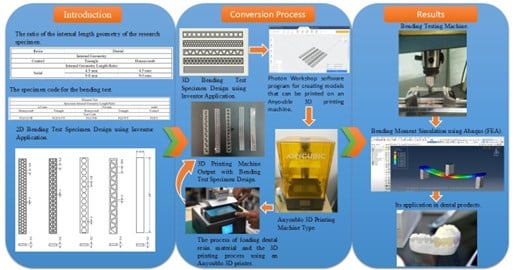
This study investigates the mechanical properties of Stereolithography (SLA) 3D printed resin in bending moment analysis using the Finite Element Method (FEM). With the growing adoption of SLA in healthcare and manufacturing, understanding mechanical performance of SLA-printed components, particularly in bending, is crucial. The research evaluates influence of printing parameters and material composition on flexural strength and flexibility of dental resin samples. It examines internal geometries such as triangle and honeycomb structures and varying thickness-to-height ratios affecting bending strength. Bending tests followed ASTM D790 standards and results were compared with FEM simulations to validate material behavior. Simulations were performed using Abaqus Student 2025 software under conditions matching experimental tests. Results show geometry and thickness-to-height ratio significantly affect bending strength, with triangle geometry outperforming honeycomb. Samples with triangle geometry and 4.5 mm ratio achieved highest bending strength of 62.743 MPa, while honeycomb 9 mm reached 55.943 MPa. Post-processing such as UV curing improves mechanical properties of resin. This study provides insights for SLA 3D printing applications in dental prosthetics and offers a framework to optimize printing parameters for performance. It contributes to the development of predictive modeling combining FEM and experimental validation for improved design of additively manufactured resin components in biomedical applications. Future work will explore broader geometries, different resin formulations, and more complex loading conditions to enhance accuracy and reliability of simulation-based design methods for SLA printed structures in engineering and medical fields as well as improve clinical applicability in dental prosthetic fabrication processes and patient outcomes overall performance.
Downloads
References
A. Ertas and A. Stroud, “Additive Manufacturing Research and Applications,” Metals, vol. 12, no. 4. p. 634, 2022. doi: 10.3390/met12040634.
D. L. Huber, “Controlling anisotropy in stereolithographically printed polymers,” J. Mater. Sci., vol. 54, no. 4, pp. 2763–2765, 2019, doi: 10.1007/s10853-018-3110-x.
G. E. Garcia, R. R. de Sousa Junior, J. R. Gouveia, and D. J. dos Santos, “Graphene Oxide-Based Nanocomposites for Stereolithography (SLA) 3D Printing: Comprehensive Mechanical Characterization under Combined Loading Modes,” Polymers, vol. 16, no. 9. p. 1261, 2024. doi: 10.3390/polym16091261.
L. Shahzadi, F. Maya, M. C. Breadmore, and S. C. Thickett, “Functional Materials for DLP-SLA 3D Printing Using Thiol–Acrylate Chemistry: Resin Design and Postprint Applications,” ACS Appl. Polym. Mater., vol. 4, no. 5, pp. 3896–3907, May 2022, doi: 10.1021/acsapm.2c00358.
D. I. Băilă and S. Tonoiu, “Properties of photo-curable polyurethane resins used in SLA manufacturing,” IOP Conf. Ser. Mater. Sci. Eng., vol. 1268, no. 1, p. 12006, 2022, doi: 10.1088/1757-899X/1268/1/012006.
V. Cordista et al., “Towards a Customizable, SLA 3D-Printed Biliary Stent: Optimizing a Commercially Available Resin and Predicting Stent Behavior with Accurate In Silico Testing,” Polymers, vol. 16, no. 14. p. 1978, 2024. doi: 10.3390/polym16141978.
A. Radić, S. M. Lambrick, S. Rhodes, and D. J. Ward, “On the application of components manufactured with stereolithographic 3D printing in high vacuum systems,” Vacuum, vol. 232, p. 113809, 2025, doi: https://doi.org/10.1016/j.vacuum.2024.113809.
D. Mitra, R. Striker, T. Nusrat, V. Gadhamshetty, B. D. Braaten, and S. Roy, “On the Prospects of Stereolithography Method for 3D Printing of Future Microwave Devices with Low-Dk,” in 2023 IEEE International Symposium on Antennas and Propagation and USNC-URSI Radio Science Meeting (USNC-URSI), 2023, pp. 939–940. doi: 10.1109/USNC-URSI52151.2023.10238087.
D. Miedzińska, R. Gieleta, and A. Popławski, “Experimental Study on Influence of Curing Time on Strength Behavior of SLA-Printed Samples Loaded with Different Strain Rates,” Materials, vol. 13, no. 24. p. 5825, 2020. doi: 10.3390/ma13245825.
K. Hata, H. Ikeda, Y. Nagamatsu, C. Masaki, R. Hosokawa, and H. Shimizu, “Development of Dental Poly(methyl methacrylate)-Based Resin for Stereolithography Additive Manufacturing,” Polymers, vol. 13, no. 24. p. 4435, 2021. doi: 10.3390/polym13244435.
Z. N. Al-Dwairi, A. A. Al Haj Ebrahim, and N. Z. Baba, “A Comparison of the Surface and Mechanical Properties of 3D Printable Denture-Base Resin Material and Conventional Polymethylmethacrylate (PMMA).,” J. Prosthodont. Off. J. Am. Coll. Prosthodont., vol. 32, no. 1, pp. 40–48, Jan. 2023, doi: 10.1111/jopr.13491.
S. I. Pop, M. Dudescu, S. G. Mihali, M. Păcurar, and D. C. Bratu, “Effects of Disinfection and Steam Sterilization on the Mechanical Properties of 3D SLA- and DLP-Printed Surgical Guides for Orthodontic Implant Placement,” Polymers, vol. 14, no. 10. p. 2107, 2022. doi: 10.3390/polym14102107.
K. Morris, A. Rosenkranz, H. Seibert, L. Ringel, S. Diebels, and F. E. Talke, “Uniaxial and Biaxial Testing of 3D Printed Hyperelastic Photopolymers,” J. Appl. Polym. Sci., vol. 137, no. 8, 2019, doi: 10.1002/app.48400.
S. Bhandari and R. A. Lopez-Anido, “Discrete-event simulation thermal model for extrusion-based additive manufacturing of pla and abs,” Materials (Basel)., vol. 13, no. 21, pp. 1–21, 2020, doi: 10.3390/ma13214985.
M. Zoumaki, M. T. Mansour, K. Tsongas, D. Tzetzis, and G. Mansour, “Mechanical Characterization and Finite Element Analysis of Hierarchical Sandwich Structures with PLA 3D-Printed Core and Composite Maize Starch Biodegradable Skins,” Journal of Composites Science, vol. 6, no. 4. p. 118, 2022. doi: 10.3390/jcs6040118.
P. Wang et al., “3D Printing of a Biocompatible Double Network Elastomer With Digital Control of Mechanical Properties,” Adv. Funct. Mater., vol. 30, no. 14, 2020, doi: 10.1002/adfm.201910391.
R. Diab, A. Enzi, and O. H. Hassoon, “Effect of Printing Parameters and Post-Curing on Mechanical Properties of Photopolymer Parts Fabricated via 3d Stereolithography Printing,” Iium Eng. J., vol. 24, no. 2, pp. 225–238, 2023, doi: 10.31436/iiumej.v24i2.2778.
A. Kafle, E. Luis, R. Silwal, H. M. Pan, P. Shrestha, and A. K. Bastola, “3d/4d Printing of Polymers: Fused Deposition Modelling (FDM), Selective Laser Sintering (SLS), and Stereolithography (SLA),” Polymers (Basel)., vol. 13, no. 18, p. 3101, 2021, doi: 10.3390/polym13183101.
K. Yoshidome, M. Torii, N. Kawamura, H. Shimpo, and C. Ohkubo, “Trueness and fitting accuracy of maxillary 3d printed complete dentures,” J. Prosthodont. Res., vol. 65, no. 4, pp. 559–564, 2021, doi: 10.2186/jpr.JPR_D_20_00240.
P. Specimens and E. I. Materi-, “Standard Test Methods for Flexural Properties of Unreinforced and Reinforced Plastics and Electrical Insulating Materials 1,” pp. 1–12, 2016, doi: 10.1520/D0790-15.
M. Pantea et al., “Compressive and Flexural Strength of 3D-Printed and Conventional Resins Designated for Interim Fixed Dental Prostheses: An In Vitro Comparison,” Materials, vol. 15, no. 9. p. 3075, 2022. doi: 10.3390/ma15093075.
N. Kumar, F. Ghani, M. A. Fareed, S. Riaz, M. S. Zafar, and M. A. Fareed, “Bi-axial flexural strength of resin based dental composites – Influence and reliability of the testing method configuration,” Mater. Technol., vol. 37, no. 12, pp. 2166–2172, 2022, doi: 10.1080/10667857.2021.1886664.
F. De Angelis et al., “Flexural Properties of Three Novel 3D-Printed Dental Resins Compared to Other Resin-Based Restorative Materials,” Prosthesis, vol. Volume 6, no. Issue 3, pp. 619–630, 2024, doi: doi.org/10.3390/prosthesis6030043.
V. Jayaraman, “Comparison of ISO and ASTM standards in determining the flexural strength of denture base resin,” vol. 53, no. March, pp. 10–13, 2019, doi: 10.26650/eor.20190072.
R. F. Almedarham et al., “Flexural properties of additive manufactured resin designated for interim fixed dental prosthesis : Effect of nanoparticles , build direction , and artificial aging,” Saudi Dent. J., vol. 36, no. 11, pp. 1417–1424, 2024, doi: 10.1016/j.sdentj.2024.08.001.
S.-M. Park, J. Park, S.-K. Kim, S. Heo, and J. Koak, “Flexural Strength of 3d-Printing Resin Materials for Provisional Fixed Dental Prostheses,” Materials (Basel)., vol. 13, no. 18, p. 3970, 2020, doi: 10.3390/ma13183970.
V. Cojocaru, “On the Behavior of Honeycomb , Grid and Triangular PLA Structures under Symmetric and Asymmetric Bending,” Micromachines, vol. Volume 14, no. Issue 1, pp. 1–18, 2023, doi: https://doi.org/10.3390/mi14010120.
U. Shah and R. Kapania, “Failure of Hexagonal and Triangular Honeycomb Core Sandwich Panels,” AIAA J., vol. 58, pp. 4923–4940, Nov. 2020, doi: 10.2514/1.J059461.
A. B. Pratama et al., “Analisis tegangan alat uji bending pipa skala laboratorium menggunakan finite element analysis,” vol. 3, no. 1, pp. 201–205, 2021, doi: doi.org/10.47233/jteksis.v3i1.214.
Copyright (c) 2026 Lita Asyriati Latif, Sukiman B, Mohammad Muzni Harbelubun, Mukhlis M, Kifli Umar, Kholqillah Ardhian Ilman

This work is licensed under a Creative Commons Attribution-NonCommercial-ShareAlike 4.0 International License.