PELACAKAN DAYA MAKSIMUM PADA PEM FUEL CELL MENGGUNAKAN PARTICLE SWARM OPTIMIZATION TERINTEGRASI INTERLEAVED BUCK-BOOST CONVERTER
Abstract
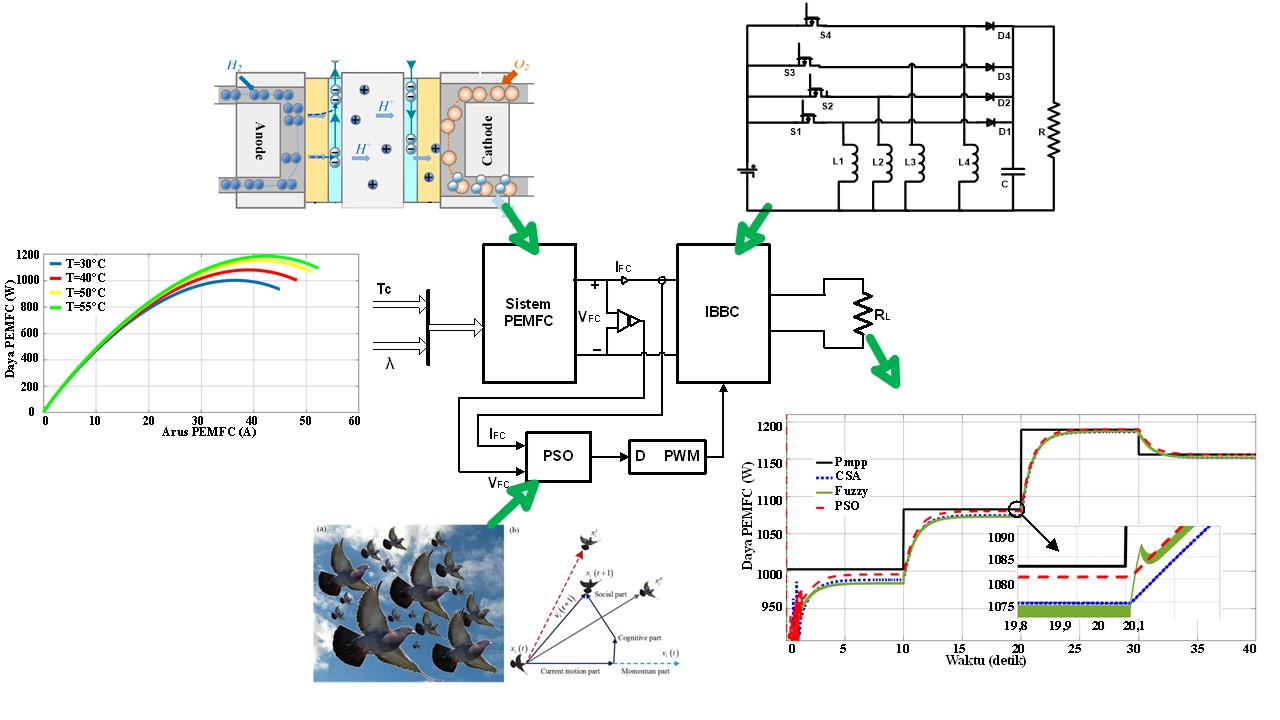
This study proposes a Maximum Power Point Tracking (MPPT) method based on Particle Swarm Optimization (PSO) to enhance power extraction performance in Proton Exchange Membrane Fuel Cell (PEMFC) systems operating under dynamic and varying environmental conditions. The proposed method is designed to optimize the system's operating point to ensure that the power generated by the fuel cell is fully utilized. In this research, the PSO algorithm is integrated with an Interleaved Boost–Buck Converter (IBBC), which functions to reduce current ripple and improve the stability of the output power in the energy conversion system. This integration is expected to provide a faster and more efficient system response in adjusting to changes in operational conditions. One of the main challenges in implementing MPPT in PEMFC-based systems is the nonlinear characteristics of PEMFC itself, which are highly influenced by various external parameters such as operating temperature, hydrogen pressure, and membrane water content. Variations in these parameters can cause fluctuations in output voltage and current, making the maximum power point tracking process more complex. Therefore, an adaptive optimization method with good convergence ability is required. Simulation results demonstrate that the proposed PSO method achieves a tracking accuracy of up to 99.96% with a settling time of 2 seconds under varying membrane water content conditions. The PSO approach also outperforms the Fuzzy Logic and Cuckoo Search Algorithm (CSA) methods. These findings confirm that the integration of PSO and IBBC significantly improves both the accuracy and speed of MPP tracking in PEMFC systems.
Downloads
References
N. P. Ang, Tze-Zhang, Mohamed Salem, Mohamad Kamarol, Himadry Shekhar Das, Mohammad Alhuyi Nazari, “A comprehensive study of renewable energy sources: Classifications, challenges and suggestions,” Energy Strateg. Rev., vol. 43, no. September 2022, p. 100939, 2022, doi: https://doi.org/10.1016/j.esr.2022.100939.
M. G. Viviana Cigolotti, “Comprehensive Review on Fuel Cell Technology for Stationary Applications as Sustainable and Efficient Poly-Generation Energy Systems,” Energies, vol. 14, no. 16, p. 4963, 2021, doi: https://doi.org/10.3390/en14164963.
J. Y. E. Y. U. N. Fam, S. Y. Wong, S. Member, K. B. Lias, S. Mekhilef, and S. Member, “Predictive Maximum Power Point Tracking for Proton Exchange Membrane Fuel Cell System,” IEEE Access, vol. 9, no. Ic, pp. 157384–157397, 2021, doi: 10.1109/ACCESS.2021.3129849.
V. Karthikeyan, “Implementation of MPPT Control in Fuel Cell Fed High Step up Ratio DC-DC Converter,” in 2018 2nd IEEE International Conference on Power Electronics, Intelligent Control and Energy Systems (ICPEICES), IEEE, 2018, pp. 689–693. doi: 10.1109/ICPEICES.2018.8897443.
N. Naseri et al., “Proton Exchange Membrane Fuel Cell Modelling and Power Control by P & O Algorithm,” in 2018 6th International Renewable and Sustainable Energy Conference (IRSEC), IEEE, 2018, pp. 1–5. doi: 10.1109/IRSEC.2018.8703002.
E. M. Barhoumi, “MPPT Control of an Interleaved Boost Converter for a Polymer Electrolyte Membrane Fuel Cell Applications,” in 2020 International Conference on ElectrICAl and Information Technologies (ICEIT), Rabat, Morocco, 2020, pp. 2–6. doi: 10.1109/ICEIT48248.2020.9113228.
H. Rezk and A. Fathy, “Performance Improvement of PEM Fuel Cell Using Variable Step-Size Incremental Resistance MPPT Technique,” Sustainability, vol. 12, no. 14, p. 5601, 2020, doi: https://doi.org/10.3390/su12145601.
D. N. Luta and A. K. Raji, “Fuzzy Rule-Based and Particle Swarm Optimisation MPPT Techniques for a Fuel Cell Stack,” Energies, vol. 12, no. 5, p. 936, 2019, doi: 10.3390/en12050936.
M. Sarvi and M. Safarishal, “New Hybrid Maximum Power Point Tracking Methods for Fuel Cell using Artificial Intelligent,” AIP Adv., vol. 13, no. 4, p. 045207, 2023, doi: 10.1063/5.0144806.
L. Fan and X. Ma, “Maximum power point tracking of PEMFC based on hybrid artificial bee colony algorithm with fuzzy control,” Sci. Rep., vol. 12, p. 4316, 2022, doi: 10.1038/s41598-022-08327-5.
M. Derbeli, O. Barambones, M. Farhat, and L. Sbita, “Efficiency Boosting for Proton Exchange Membrane Fuel Cell Power System Using New MPPT Method,” in 2019 10th International Renewable Energy Congress (IREC), IEEE, 2019, pp. 1–4. doi: 10.1109/IREC.2019.8754587.
S. Somkun, C. Sirisamphanwong, and S. Sukchai, “A DSP-based interleaved boost DC – DC converter for fuel cell applications,” Int. J. Hydrogen Energy, vol. 40, no. April, pp. 6391–6404, 2015, doi: 10.1016/j.ijhydene.2015.03.069.
S. A. Ansari et al., “Modeling and Simulation of a Proton Exchange Membrane Fuel Cell Alongside a Waste Heat Recovery System Based on the Organic Rankine Cycle in MATLAB / SIMULINK Environment,” Sustainability, vol. 13, no. 3, p. 1218, 2021, doi: https://doi.org/10.3390/su13031218.
B. N. Alajmi and M. I. Marei, “Multiphase Interleaved Converter Based on Cascaded Non-Inverting Buck-Boost Converter,” IEEE Access, vol. 10, pp. 42497–42506, 2022, doi: 10.1109/ACCESS.2022.3168389.
P. P. Surya, D. Irawan, and M. Zuhri, “Review and Comparison Of DC-DC Converters For Maximum Power Point Tracking System In Standalone Photovoltaic ( PV ) Module,” in 2017 International Conference on Advanced Mechatronics, Intelligent Manufacture, and Industrial Automation (ICAMIMIA), IEEE, 2017, pp. 242–247. doi: 10.1109/ICAMIMIA.2017.8387595.
I. Laoprom and S. Tunyasrirut, “Design of PI Controller for Voltage Controller of Four-Phase Interleaved Boost Converter Using Particle Swarm Optimization,” J. Control Sci. Eng., vol. 2020, no. 1, pp. 1–13, 2020, doi: https://doi.org/10.1155/2020/9515160.
P. Putra, F. E. Nuruli, F. S. Hadi, and R. O. Saputra, “Pengukuran Potensi Energi Matahari Dan Perancangan Plts Terhubung Jaringan Pada Gedung Laboratorium Teknik 1 ITERA,” SJME Kinemat., vol. 9, no. 1, pp. 12–24, 2024, doi: 10.20527/sjmekinematika.v9i1.257.
et al. S. Rafikiran, “Design and performance analysis of hybrid MPPT controllers for fuel cell fed DC-DC converter systems,” Energy Reports, vol. 9, pp. 5826–5842, 2023, doi: https://doi.org/10.1016/j.egyr.2023.05.030.
and T. N. Arianto, M. Hasan Basri, “Perancangan Maximum Power Point Tracking (Mppt) Kontrol Pada Prototype Traffic Light System Menggunakan PID Control,” SJME Kinemat., vol. 5, no. 2, pp. 109–118, doi: https://doi.org/10.20527/sjmekinematika.v5i2.170.
S. Ahmadi, S. Abdi, and M. Kakavand, “Maximum power point tracking of a proton exchange membrane fuel cell system using PSO-PID controller,” Int. J. Hydrogen Energy, vol. 42, no. 32, pp. 20430–20443, 2017, doi: 10.1016/j.ijhydene.2017.06.208.
Copyright (c) 2026 Pressa P. S. Saputra, Zainal Mustakim, Heri Ardiansyah, Rifqi Firmansyah

This work is licensed under a Creative Commons Attribution-NonCommercial-ShareAlike 4.0 International License.