IMPACT OF PYROLYSIS TEMPERATURE ON PINE CONE ACTIVATED CARBON FOR CATALYST SUPORT MATERIAL FUEL CELL
Abstract
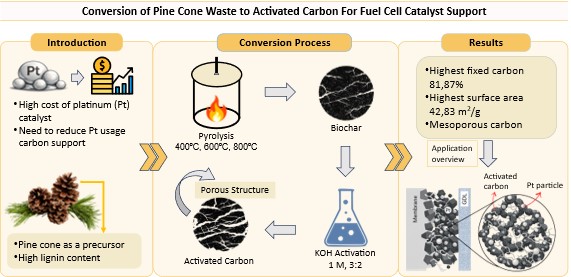
The high cost and limited durability of platinum-based catalysts remain major challenges for the large-scale commercialization of fuel cell. Therefore, alternative and more affordable catalyst support materials are needed. Biomass derived activated carbon offers a promising solution due to its porous structure, good electrical conductivity, and abundant raw material availability. This study aims to investigate the potential of Pinus merkusii pine cones as a precursor for activated carbon through pyrolysis and chemical activation using potassium hydroxide (KOH), as well as to evaluate its suitability as a fuel cell catalyst support material. Pyrolysis was conducted at temperatures of 400ºC, 600ºC, and 800ºC under a nitrogen inert atmosphere, followed by chemical activation. The resulting activated carbon was characterized using proximate analysis and Brunauer-Emmett-Teller (BET) analysis. The results indicate that increasing the pyrolysis temperature led to a reduction in biochar yield, moisture content, ash content, and volatile matter, while consistently enhancing the fixed carbon content and specific surface area. The optimal condition was achieved at a pyrolysis temperature of 800ºC, producing activated carbon with the highest fixed carbon content of 81.87%, a specific surface area of 42.83 m2/g, and a mesoporous structure with an average pore diameter of 3.23 nm. Nevertheless, the obtained specific surface area remains below the ideal value (>100 m²/g) for application as a fuel cell catalyst support, indicating that the synthesized material still requires further optimization in both the process and activation conditions.
Downloads
References
I. Sebbani, M. K. Ettouhami, and M. Boulakhbar, “Fuel cells: A technical, environmental, and economic outlook,” Cleaner Energy Systems, vol. 10, p. 100168, Jun. 2025, doi: 10.1016/j.cles.2024.100168.
A. L. Dicks and D. A. J. Rand, Fuel cell systems explained, Third edition. Hoboken, NJ, USA: Wiley, 2018. doi: 10.1002/9781118706992.
W. Mabhulusa, K. E. Sekhosana, and X. Fuku, “The impact and performance of carbon-supported platinum group metal electrocatalysts for fuel cells,” International Journal of Electrochemical Science, vol. 19, no. 4, p. 100524, Apr. 2024, doi: 10.1016/j.ijoes.2024.100524.
X. Zeng, S. Shahgaldi, S. K. Mitra, and X. Li, “Impact of carbon supports on the Pt-based catalyst activity and fuel cell performance under varied operational conditions,” Energy Conversion and Management, vol. 326, p. 119496, Feb. 2025, doi: 10.1016/j.enconman.2025.119496.
S. Samad et al., “Carbon and non-carbon support materials for platinum-based catalysts in fuel cells,” International Journal of Hydrogen Energy, vol. 43, no. 16, pp. 7823–7854, Apr. 2018, doi: 10.1016/j.ijhydene.2018.02.154.
S. Mehdipour-Ataei and E. Aram, “Mesoporous Carbon-Based Materials: A Review of Synthesis, Modification, and Applications,” Catalysts, vol. 13, no. 1, p. 2, Dec. 2022, doi: 10.3390/catal13010002.
A. Y. Sabitah, I. N. Ardiyat, M. Misbachudin, I. U. Wusko, and R. P. Ningsih, “Analisis Proses Pirolisis Limbah Plastik HDPE Dan PET: Pengaruh Temperatur Dan Waktu Reaksi Dalam Upaya Daur Ulang Plastik,” SJMEkinematika, vol. 9, no. 1, pp. 98–106, Jun. 2024, doi: 10.20527/sjmekinematika.v9i1.318.
A. A. Boateng, Pyrolysis of Biomass for Fuels and Chemicals. San Diego: Elsevier Science & Technology, 2020.
A. Al-Rumaihi, M. Shahbaz, G. Mckay, H. Mackey, and T. Al-Ansari, “A review of pyrolysis technologies and feedstock: A blending approach for plastic and biomass towards optimum biochar yield,” Renewable and Sustainable Energy Reviews, vol. 167, p. 112715, Oct. 2022, doi: 10.1016/j.rser.2022.112715.
P. Basu, Biomass gasification, pyrolysis, and torrefaction: practical design and theory, 2nd edition. Amsterdam: Academic Press, 2013.
Y. K N et al., “Lignocellulosic biomass-based pyrolysis: A comprehensive review,” Chemosphere, vol. 286, p. 131824, Jan. 2022, doi: 10.1016/j.chemosphere.2021.131824.
M. Macena, L. Cruz-Lopes, L. Grosche, B. Esteves, I. Santos-Vieira, and H. Pereira, “Valorization of Pinecones as Biosorbents for Environmental Remediation of Zn-Contaminated Wastewaters,” Environments, vol. 12, no. 8, p. 284, Aug. 2025, doi: 10.3390/environments12080284.
S. Valizadeh, H. Younesi, and N. Bahramifar, “Preparation and Characterization of Activated Carbon from the Cones of Iranian Pine Trees (Pinus eldarica) by Chemical Activation with H3PO4 and Its Application for Removal of Sodium Dodecylbenzene Sulfonate Removal from Aqueous Solution,” Water Conserv Sci Eng, vol. 3, no. 4, pp. 253–265, Dec. 2018, doi: 10.1007/s41101-018-0055-5.
M. A. Martín-Lara, G. Blázquez, A. Ronda, and M. Calero, “Kinetic study of the pyrolysis of pine cone shell through non-isothermal thermogravimetry: Effect of heavy metals incorporated by biosorption,” Renewable Energy, vol. 96, pp. 613–624, Oct. 2016, doi: 10.1016/j.renene.2016.05.026.
E. E. Mbamalu and I. Y. Mohammed, “Co-valorisation of cassava peel and rice husk to biofuel precursor via intermediate pyrolysis: Kinetics, thermodynamic and pyrolytic oil characterisation,” Waste Management Bulletin, vol. 2, no. 4, pp. 194–208, Dec. 2024, doi: 10.1016/j.wmb.2024.11.004.
X. Fu, Q. Li, and C. Hu, “Identification and structural characterization of oligomers formed from the pyrolysis of biomass,” Journal of Analytical and Applied Pyrolysis, vol. 144, p. 104696, Nov. 2019, doi: 10.1016/j.jaap.2019.104696.
Y. Jari et al., “Porous activated carbons derived from waste Moroccan pine cones for high-performance adsorption of bisphenol A from water,” Heliyon, vol. 10, no. 9, p. e29645, May 2024, doi: 10.1016/j.heliyon.2024.e29645.
F. B. Benabed et al., “Theoretical study of the herbicide parachlorophenoxyacetic acid molecule and its removal by activated carbon prepared from pine cone,” Desalination and Water Treatment, vol. 320, p. 100719, Oct. 2024, doi: 10.1016/j.dwt.2024.100719.
M. I. Sari, M. G. Markasiwi, and R. W. Putri, “Physical Characteristic Test Of Active Carbon From Pineapple Leaves Waste (Ananas Comosus) Using H3PO4 Activator,” vol. 12, no. 02, 2021.
P. K. Bhattacharya, “Water flooding in the proton exchange membrane fuel cell,” vol. 15, 2015.
M. A. Yahya, Z. Al-Qodah, and C. W. Z. Ngah, “Agricultural bio-waste materials as potential sustainable precursors used for activated carbon production: A review,” Renewable and Sustainable Energy Reviews, vol. 46, pp. 218–235, Jun. 2015, doi: 10.1016/j.rser.2015.02.051.
A. Asmunandar, F. Goembira, S. Raharjo, and R. Yuliarningsih, “Evaluasi Pengaruh Suhu dan Waktu Pirolisis Biochar Bambu Betung (Dendrocalamus asper),” 2023.
L. K. Palniandy, L. W. Yoon, W. Y. Wong, S.-T. Yong, and M. M. Pang, “Application of Biochar Derived from Different Types of Biomass and Treatment Methods as a Fuel Source for Direct Carbon Fuel Cells,” Energies, vol. 12, no. 13, p. 2477, Jun. 2019, doi: 10.3390/en12132477.
C. Munnings, A. Kulkarni, S. Giddey, and S. P. S. Badwal, “Biomass to power conversion in a direct carbon fuel cell,” International Journal of Hydrogen Energy, vol. 39, no. 23, pp. 12377–12385, Aug. 2014, doi: 10.1016/j.ijhydene.2014.03.255.
M. N. Alam, “Pengaruh Suhu Pirolisis Terhadap Kadar Fixed Carbon Dari Karbon Aktif Kulit Batang Sagu,” Cokroaminoto Journal of Chemical Science, vol. 4, no. 2, 2022.
M. Z. Rahman, T. Edvinsson, and P. Kwong, “Biochar for electrochemical applications,” Current Opinion in Green and Sustainable Chemistry, vol. 23, pp. 25–30, Jun. 2020, doi: 10.1016/j.cogsc.2020.04.007.
T. Yumak, “Surface characteristics and electrochemical properties of activated carbon obtained from different parts of Pinus pinaster,” Colloids and Surfaces A: Physicochemical and Engineering Aspects, vol. 625, p. 126982, Sep. 2021, doi: 10.1016/j.colsurfa.2021.126982.
L. Sun, S. Zhao, J. Wei, Y. Li, D. Wu, and C. Wu, “Quantitative Analysis of the Influence of Volatile Matter Content in Coal Samples on the Fractal Dimension of Their Nanopore Characteristics,” Applied Sciences, vol. 15, no. 13, p. 7236, Jun. 2025, doi: 10.3390/app15137236.
G. Wang et al., “Recent Progress in Using Mesoporous Carbon Materials as Catalyst Support for Proton Exchange Membrane Fuel Cells,” Nanomaterials, vol. 13, no. 21, p. 2818, Oct. 2023, doi: 10.3390/nano13212818.
Copyright (c) 2026 Pebi Riyanto, Trisma Jaya Saputra, Rany Puspita Dewi, Sigit Mujiarto, Raka Mahendra Sulistiyo

This work is licensed under a Creative Commons Attribution-NonCommercial-ShareAlike 4.0 International License.