ENHANCING PHOTOVOLTAIC EFFICIENCY USING SERPENTINE LIQUID COOLING UNDER VARYING FLOW RATES IN TROPICAL CLIMATES
Abstract
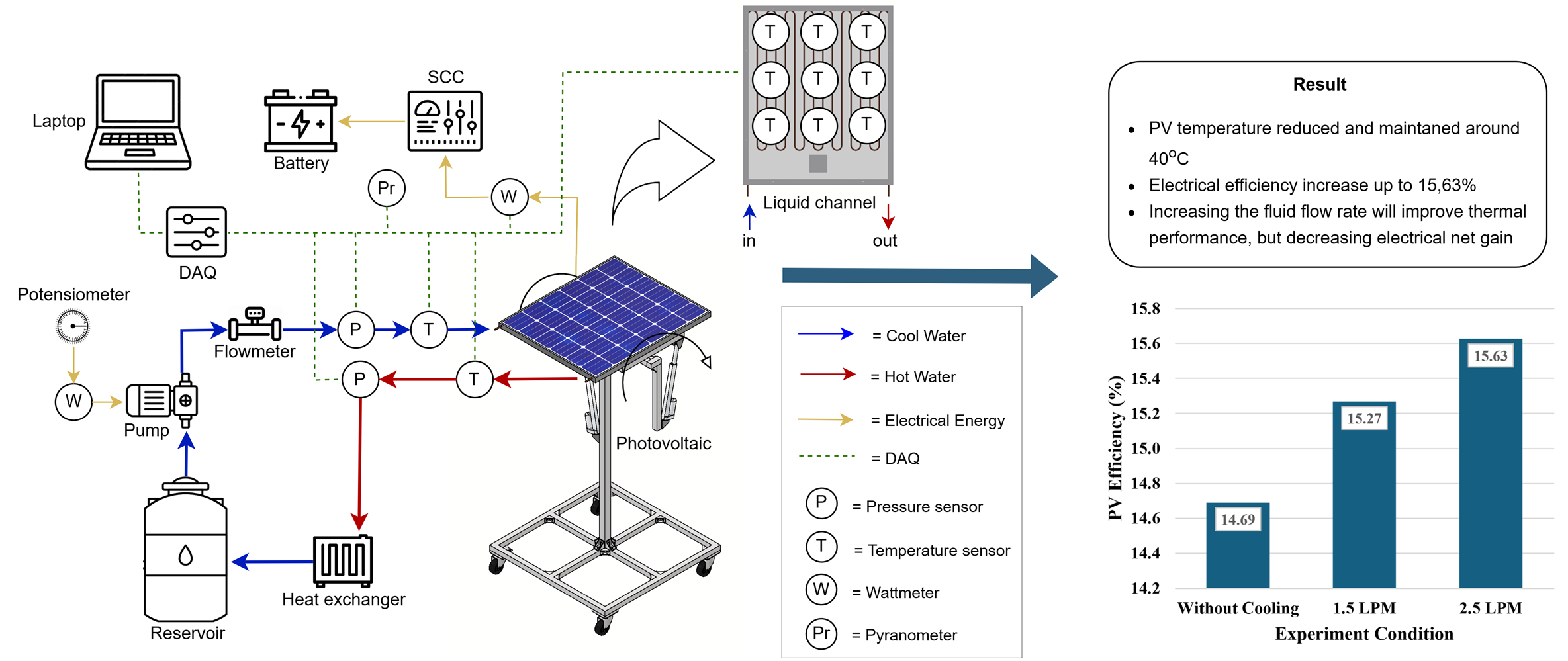
Global growth in electricity demand and the environmental impact of fossil fuels have accelerated the adoption of photovoltaic (PV) technology. However, PV efficiency significantly degrades under high outdoor thermal loads, where every 1°C rise in temperature reduces efficiency by approximately 0.3-0.5%. This study evaluates an active thermal management system (TMS) based on a serpentine liquid channel integrated with a dual-axis solar tracker on a 100 Wp monocrystalline PV module. Outdoor experimental research was conducted at Universitas Gadjah Mada in April 2026. Water flow rates of 1.5 LPM and 2.5 LPM were analyzed to determine their impact on performance. To ensure a fair comparative evaluation under dynamic weather conditions, cooling performance was evaluated against an analytical non-cooled baseline calculated using standard STC coefficients driven by real-time environmental data. The results demonstrate that the TMS significantly lowered cell temperatures. At 1.5 LPM, the average temperature reduction was 12.43°C, while 2.5 LPM achieved a better reduction of 14.58°C. The heat transfer coefficient increased by 43.1%, rising from 322.77 W/m²K at 1.5 LPM to 461.89 W/m²K at 2.5 LPM. Consequently, average gross electrical efficiency improved from a non-cooled of 14.69% to 15.63% at 2.5 LPM, representing a 6.4% relative increase. While the 2.5 LPM flow rate achieved the better gross electrical efficiency, the 1.5 LPM configuration yielded slightly better net efficiency after accounting for the pump load. These findings confirm that increasing water flow rates within serpentine channels effectively maintains the PV temperature and improves its gross efficiency.
Downloads
References
M. A. Nasution, H. Ambarita, and I. Siregar, “Social and technical barriers that affect the growth of small-scale hydropower independent power producers in Indonesia,” in IOP Conference Series: Materials Science and Engineering, Institute of Physics Publishing, Oct. 2018. doi: 10.1088/1757-899X/420/1/012041.
A. Azouzoute et al., “Modeling and experimental investigation of dust effect on glass cover PV module with fixed and tracking system under semi-arid climate,” Solar Energy Materials and Solar Cells, vol. 230, Sep. 2021, doi: 10.1016/j.solmat.2021.111219.
B. Zhao, M. Hu, X. Ao, Q. Xuan, Z. Song, and G. Pei, “Is it possible for a photovoltaic-thermoelectric device to generate electricity at night?,” Solar Energy Materials and Solar Cells, vol. 228, Aug. 2021, doi: 10.1016/j.solmat.2021.111136.
P. Sudhakar, R. Santosh, B. Asthalakshmi, G. Kumaresan, and R. Velraj, “Performance augmentation of solar photovoltaic panel through PCM integrated natural water circulation cooling technique,” Renew. Energy, vol. 172, pp. 1433–1448, Jul. 2021, doi: 10.1016/j.renene.2020.11.138.
L. Huang et al., “Surface temperature and power generation efficiency of PV arrays with various row spacings: A full-scale outdoor experimental study,” Appl. Energy, vol. 367, Aug. 2024, doi: 10.1016/j.apenergy.2024.123362.
H. Raad, S. Ali, J. Faraj, C. Castelain, K. Chahine, and M. Khaled, “Enhancing photovoltaic performance through water-based cooling: a comprehensive review of passive and active techniques,” Jan. 15, 2026, Elsevier Ltd. doi: 10.1016/j.applthermaleng.2025.128943.
S. Nižetić, E. Giama, and A. M. Papadopoulos, “Comprehensive analysis and general economic-environmental evaluation of cooling techniques for photovoltaic panels, Part II: Active cooling techniques,” Energy Convers. Manag., vol. 155, pp. 301–323, Jan. 2018, doi: 10.1016/J.ENCONMAN.2017.10.071.
N. Reza and N. Mondol, “Design and implementation of an automatic single axis tracking with water-cooling system to improve the performance of solar photovoltaic panel,” in 2021 International Conference on Automation, Control and Mechatronics for Industry 4.0, ACMI 2021, Institute of Electrical and Electronics Engineers Inc., Jul. 2021. doi: 10.1109/ACMI53878.2021.9528189.
F. Bayrak, A. Gönül, and M. Camci, “Thermal management of photovoltaic panels using configurations of spray cooling systems,” Appl. Therm. Eng., vol. 274, Sep. 2025, doi: 10.1016/j.applthermaleng.2025.126656.
B. Jiang et al., “Experimental and numerical investigation of photovoltaic modules with rear spray cooling system,” Appl. Therm. Eng., vol. 284, Jan. 2026, doi: 10.1016/j.applthermaleng.2025.129035.
M. A. Rahman, I. Pranoto, Y. Yunus, and Khasani, “Cooling system performance and efficiency of mini-channel cold plate in various flow regimes,” AIP Conf. Proc., vol. 3090, no. 1, p. 060006, Oct. 2024, doi: 10.1063/5.0227763.
M. A. Rahman, Y. Yunus, I. Pranoto, Khasani, and D. W. Djamari, “Heat transfer performance of serpentine mini-channel cold plate in various Reynolds numbers,” AIP Conf. Proc., vol. 3120, no. 1, p. 020024, Feb. 2025, doi: 10.1063/5.0227762.
C. S. Chin, Z. Gao, M. Han, and C. Zhang, “Enhancing performance of photovoltaic panel by cold plate design with guided channels,” IET Renewable Power Generation, vol. 14, no. 9, pp. 1606–1617, Jul. 2020, doi: 10.1049/iet-rpg.2019.1042.
A. Saxena, S. Deshmukh, S. Nirali, and S. Wani, “Laboratory based Experimental Investigation of Photovoltaic (PV) Thermo-control with Water and its Proposed Real-time Implementation,” Renew. Energy, vol. 115, pp. 128–138, Jan. 2018, doi: 10.1016/j.renene.2017.08.029.
A. L. Abdullah, S. Misha, N. Tamaldin, M. A. M. Rosli, and F. A. Sachit, “Theoretical study and indoor experimental validation of performance of the new photovoltaic thermal solar collector (PVT) based water system,” Case Studies in Thermal Engineering, vol. 18, Apr. 2020, doi: 10.1016/j.csite.2020.100595.
K. Yeranee, C. Xu, Y. Rao, and Y. Zhang, “Experimental and numerical study of improving flow and heat transfer in a serpentine cooling channel with topology-optimized TPMS porous structures,” Int. J. Heat Mass Transf., vol. 231, Oct. 2024, doi: 10.1016/j.ijheatmasstransfer.2024.125873.
T. A. Dabbousa, I. Al-Reqeb, S. Mansour, and M. A. A. M. Zainuri, “The Effect of Tilting a PV Array by Monthly or Seasonal Optimal Tilt Angles on Energy Yield of a Solar PV System,” in 2021 International Conference on Electric Power Engineering - Palestine, ICEPE-P 2021, Institute of Electrical and Electronics Engineers Inc., Mar. 2021. doi: 10.1109/ICEPE-P51568.2021.9423475.
R. S. Rahmany, Jefri Aldo, and Halim, “SIMULASI PENGGUNAAN PANEL SURYA ATAP DI LINGKUNGAN KAMPUS POLITEKNIK BATULICIN,” Scientific Journal of Mechanical Engineering Kinematika, vol. 8, no. 1, pp. 74–84, Jun. 2023, doi: 10.20527/sjmekinematika.v8i1.254.
H. A. Kazem, M. T. Chaichan, A. H. A. Al-Waeli, and K. Sopian, “Photovoltaic performance with three-position tracking and enhanced heat sink cooling system,” Global Energy Interconnection, Dec. 2025, doi: 10.1016/j.gloei.2025.07.006.
K. Sopian et al., “Performance analysis of photovoltaic panels with dual-axis tracking and passive cooling using fins and radiative paint,” Solar Energy, vol. 302, Dec. 2025, doi: 10.1016/j.solener.2025.114047.
K. Płachta, J. Mroczka, and M. Ostrowski, “A New Approach To Water Cooling Of Photovoltaic Panels With A Tracking System,” Metrology and Measurement Systems, vol. 30, no. 4, pp. 675–687, 2023, doi: 10.24425/mms.2023.147961.
M. R. Sharaby, S. W. Sharshir, A. A. ElBahloul, A. W. Kandeal, and M. Rashad, “Performance evaluation of fixed and sun-tracking photovoltaic systems integrated with spray cooling,” Solar Energy, vol. 288, Mar. 2025, doi: 10.1016/j.solener.2025.113310.
M. M. Abd-Elhady, O. M. Agwa, M. K. Bayoumy, R. B. Rizk, and I. I. El-Sharkawy, “Experimental investigation of hybrid photovoltaic-thermal system: Integration of concentration, tracking, and cooling mechanisms,” Solar Energy, vol. 299, Oct. 2025, doi: 10.1016/j.solener.2025.113759.
A. N. Maulana, A. K. Samlawi, and M. Rijali, “Analisis Pengaruh Lebar Celah Udara Pada Channel Outlet Terhadap Kondisi Ruangan Dan Daya Listrik Dengan Memanfaatkan Panel Surya”, Scientific Journal of Mechanical Engineering Kinematika, vol. 3, no. 1, pp. 17-32, Jun. 2018, doi: 10.20527/sjmekinematika.v3i1.3.
Solana Indonesia, “Monocrystalline 100W-SNI.” Accessed: Sep. 23, 2025. [Online]. Available: https://solana.co.id/mono
Graphtec Corporation, “Isolated Multi-CH data LOGGER GL860.” Accessed: Apr. 23, 2026. [Online]. Available: https://www.graphteccorp.com/logger/gl860
HOBO Data Loggers, “Solar Radiation (Silicon Pyranometer) Smart Sensor Specification.” Accessed: Apr. 23, 2026. [Online]. Available: https://www.onsetcomp.com/products/sensors/s-lib-m003 _
J. A. Duffie and W. A. Beckman, Solar Engineering of Thermal Processes, 4th ed. Hoboken, NJ, USA: Wiley, 2013.
G. S. Menon, S. Murali, J. Elias, D. S. Aniesrani Delfiya, P. V. Alfiya, and M. P. Samuel, “Experimental investigations on unglazed photovoltaic-thermal (PVT) system using water and nanofluid cooling medium,” Renew. Energy, vol. 188, pp. 986–996, Apr. 2022, doi: 10.1016/j.renene.2022.02.080.
M. Veeramanikandan, T. V. Arjunan, and P. Jidhesh, “Experimental investigation of sandwich glazed solar photovoltaic Module,” in Materials Today: Proceedings, Elsevier Ltd, Jan. 2020, pp. 136–139. doi: 10.1016/j.matpr.2019.09.069.
Y. Ji, J. Zhou, B. Emmanuel, L. Wang, L. Lu, and Y. Yuan, “Assessment of factors affecting the performance of a novel double condenser heat pipe Photovoltaic-thermal (PV/T) system in hot water mode: An experimental study in the lab,” Thermal Science and Engineering Progress, vol. 37, Jan. 2023, doi: 10.1016/j.tsep.2022.101607.
A. A. Kristi, E. Susanto, A. Risdiyanto, A. Junaedi, R. Darussalam, N. A. Rachman, A. Fudholi, “Energy analysis of active photovoltaic cooling system using water flow,” International Journal of Electrical and Computer Engineering, vol. 15, no. 1, pp. 1–14, Feb. 2025, doi: 10.11591/ijece.v15i1.pp1-14.
Copyright (c) 2026 Bintang Arif Prasetya, Indro Pranoto, Fauzun

This work is licensed under a Creative Commons Attribution-NonCommercial-ShareAlike 4.0 International License.