EFFECT OF SUV BODY GEOMETRY ON AERODYNAMIC DRAG AND FUEL EFFICIENCY USING CFD
Abstrak
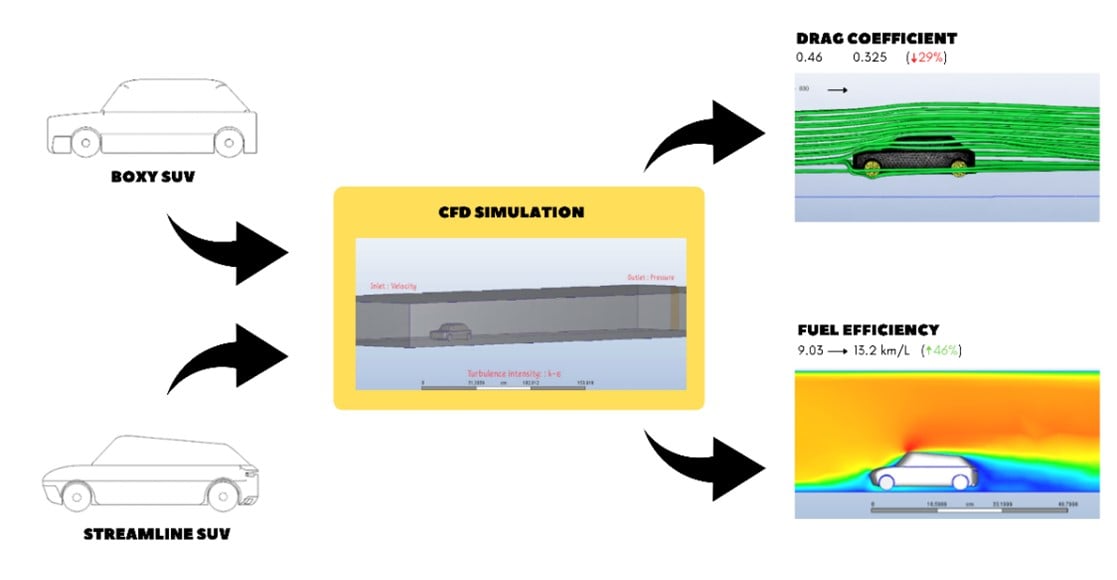
The increasing demand for fuel efficiency in the automotive industry, particularly in the sport utility vehicle (SUV) segment, has intensified research on factors influencing vehicle energy efficiency. One of the most important factors is vehicle aerodynamic performance, especially air resistance characterized by the drag coefficient. This study analyzes the influence of SUV body shape variations on aerodynamic performance and fuel consumption using Computational Fluid Dynamics (CFD) simulations. Two SUV models with different body geometries, namely boxy and streamlined configurations, were analyzed under identical operating conditions to ensure a consistent comparison. The simulation results show that the streamlined model reduces the drag coefficient from 0.46 to 0.325, corresponding to an approximate 29% reduction compared to the boxy configuration. This aerodynamic improvement is associated with better fuel efficiency, particularly at higher vehicle speeds. At a speed of 120 km/h, the streamlined configuration achieves a fuel efficiency of 13.2 km/L, while the boxy configuration reaches only 9.03 km/L under the same conditions. These findings indicate that optimizing vehicle body geometry through aerodynamic design can significantly improve fuel efficiency and reduce aerodynamic resistance in SUV vehicles.
##plugins.generic.usageStats.downloads##
Referensi
Xinshuai, F. Xie, T. Ji, Z. Zhu, and Y. Zheng, “Multi-fidelity deep neural network surrogate model for aerodynamic shape optimization,” Comput. Methods Appl. Mech. Eng., vol. 373, p. 113485, 2021, doi: 10.1016/j.cma.2020.113485.
E. Johansson, S. Andersson, and H. Nilsson, “Optimization of aerodynamics for improved fuel efficiency in passenger vehicles,” Int. J. Automob. Eng., vol. 6, no. 2, pp. 10–16, 2025, doi: https://www.doi.org/10.22271/27078205.2025.v6.i2a.56.
C. Zhang, “Exploring the Influence of Vehicle Body Designs on Aerodynamic Drag,” vol. 120, pp. 376–383, 2024, doi: https://doi.org/10.54097/wxzrzs08
J. Kou and W. Zhang, “Data-driven modeling for unsteady aerodynamics and aeroelasticity,” Prog. Aerosp. Sci., vol. 125, p. 100725, 2021, doi: https://doi.org/10.1016/j.paerosci.2021.100725.
J. Li, X. Du, and J. R. R. A. Martins, “Machine learning in aerodynamic shape optimization,” Prog. Aerosp. Sci., vol. 134, p. 100849, 2022, doi: https://doi.org/10.1016/j.paerosci.2022.100849.
A. Al-Saadi et al., “Improvement of the aerodynamic behavior of a sport utility vehicle numerically by using some modifications and aerodynamic devices,” Sci. Rep., vol. 12, no. 1, p. 20272, 2022, doi: 10.1038/s41598-022-24328-w.
Z. Lei et al., “Energy efficiency optimization of passenger vehicles considering aerodynamic wake flow influence in car-following scenarios,” Energy, vol. 328, p. 136501, 2025, doi: https://doi.org/10.1016/j.energy.2025.136501.
B. Junaidin, “Aerodynamic Analysis Of Sport Utility Vehicle (SUV) By Computational Fluid Dynamics (CFD) Aproach,” Vortex, vol. 03, pp. 67–74, 2022, doi: http://dx.doi.org/10.28989/vortex.v3i1.1161.
X. Yan, Z. Ma, X. Liu, and L. Jiang, “Research on Aerodynamic Performance Optimization and Drag Reduction of mid ‐ sized SUV on CFD,” vol. 6, no. 5, pp. 80–88, 2024, doi: https://doi.org/10.54691/7prepw68.
T. Schuetz, Aerodynamics of Road Vehicles, Fifth Edit. Warrendale, Pennsylvania USA: SAE International, 2016.
F. M. White, Fluid Mechanics, Eighth Edi. 2 Penn Plaza, New York, United States of America: McGraw-Hill Education, 2016.
S. Wang, T. Avadiar, M. C. Thompson, and D. Burton, “Effect of moving ground on the aerodynamics of a generic automotive model: The DrivAer-Estate,” J. Wind Eng. Ind. Aerodyn., vol. 195, p. 104000, 2019, doi: https://doi.org/10.1016/j.jweia.2019.104000.
Karl-Heinz Dietsche, Automotive Handbook, 11th Editi. Friedrichshafen and Karlsruhe: Robert Bosch GmbH, 2022.
R. Pratama, “Pengaruh Desain Aerodinamika Terhadap Efisiensi Bahan Bakar pada Kendaraan Bermotor Listrik,” J. Eng. Technol. Sci., vol. 1, no. 2, pp. 54–60, 2025, doi: https://doi.org/10.70716/jets.v1i2.132.
P. Qin, A. Ricci, and B. Blocken, “CFD simulation of aerodynamic forces on the DrivAer car model: Impact of computational parameters,” J. Wind Eng. Ind. Aerodyn., vol. 248, p. 105711, 2024, doi: https://doi.org/10.1016/j.jweia.2024.105711.
N. Kuttasirisuk, P. Munikanon, N. Ajavakom, P. Silva, and G. Phanomchoeng, “Simulation-Guided Aerodynamic Design and Scaled Verification for High-Performance Sports Cars,” Modelling, vol. 6, Sep. 2025, doi: 10.3390/modelling6030105.
V. Goel, A. Chopra, P. Tripathy, and M. Kumar, “Aerodynamics studies of various passenger vehicles using Computational Fluid Dynamics (CFD),” vol. Volume 15, pp. 1–9, Dec. 2024, doi: 10.5281/zenodo.14499663.
F. Alam, S. Watkins, and Y. Jin, “Passenger Car Aerodynamic Drag , Thermal Cooling : A Perspective for Energy Saving and Improving Environment,” pp. 1–31, 2025.
J. Li, X. Zhu, C. Zhang, S. Dang, and G. Chen, “CFD Simulation of Passenger Car Aerodynamics and Body Parameter Optimization,” Fluid Dyn. Mater. Process., vol. 21, no. 9, pp. 2305–2329, 2025, doi: https://doi.org/10.32604/fdmp.2025.067087.
##submission.copyrightStatement##
##submission.license.cc.by-nc-sa4.footer##