EFFECT OF NaOH AND Ca(OH)₂ ALKALI TREATMENT TIME ON PURUN TIKUS FIBER PROPERTIES
Abstrak
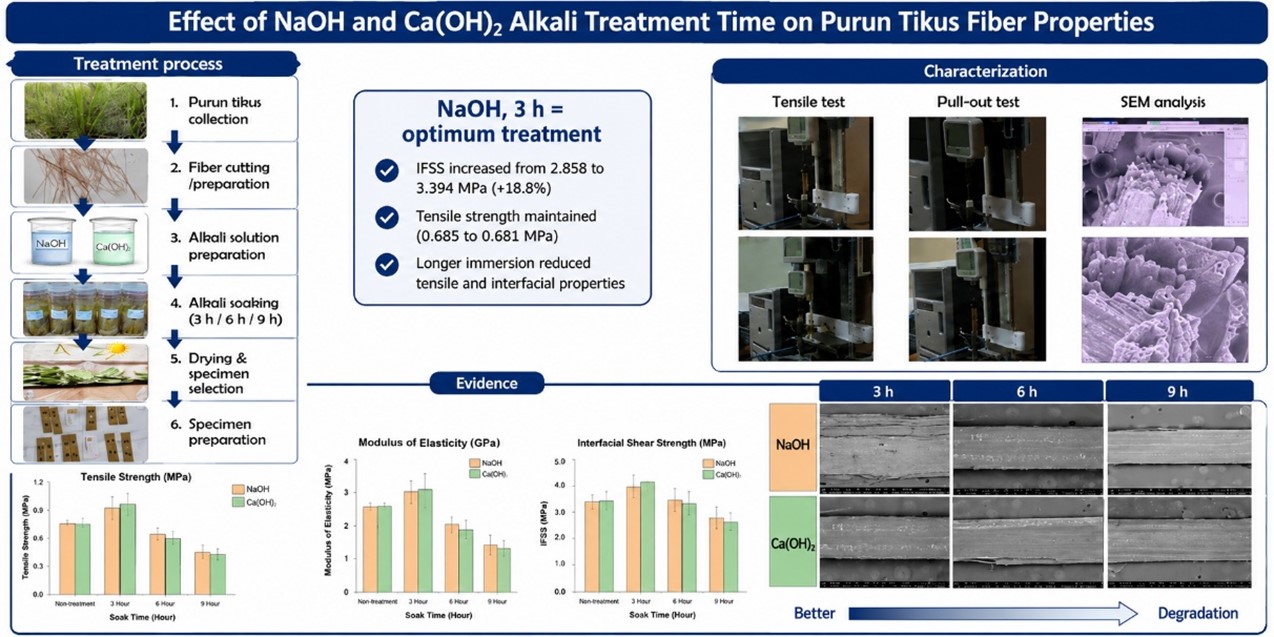
Purun tikus fiber (Eleocharis dulcis) is a promising natural fiber for environmentally friendly composite reinforcement due to its abundant availability and relatively high cellulose content. However, the presence of lignin, hemicellulose, and surface impurities can reduce interfacial bonding and mechanical performance. This study investigated the effect of alkali treatment type and immersion time on the mechanical and morphological properties of single purun tikus fibers. The fibers were treated in 5 wt.% NaOH and Ca(OH)₂ solutions for 3, 6, and 9 h, with three specimens prepared for each treatment variation. Mechanical characterization included single-fiber tensile testing based on ASTM C1557 to determine tensile strength, strain, and elastic modulus, pull-out testing to evaluate interfacial shear strength, and field emission scanning electron microscopy (FESEM) analysis to observe surface morphology changes. The results showed that the the most favorable treatment condition was obtained using NaOH for 3 h. Under this condition, the interfacial shear strength increased from 2.858 MPa to 3.394 MPa, corresponding to an improvement of approximately 18.8%, while the tensile strength was maintained at 0.681 MPa, close to that of the untreated fiber (0.685 MPa). In contrast, longer immersion times of 6 and 9 h reduced the tensile strength and interfacial performance, indicating fiber degradation due to excessive alkalization. FESEM observations confirmed that short-duration alkali treatment improved surface cleanliness and roughness, whereas prolonged treatment caused cracks and structural damage. These findings indicate that controlled NaOH treatment is more effective than Ca(OH)₂ in improving the suitability of purun tikus fiber as a composite reinforcement.
##plugins.generic.usageStats.downloads##
Referensi
R. Rodiawan, S. Suhdi, and F. Rosa, “Analisa Sifat-Sifat Serat Alam Sebagai Penguat Komposit Ditinjau Dari Kekuatan Mekanik,” Turbo J. Progr. Stud. Tek. Mesin, vol. 5, no. 1, 2017, doi: 10.24127/trb.v5i1.117.
D. E. Natanael Siagian and M. H. Sedo Putra, “Serat Alam Sebagai Bahan Komposit Ramah Lingkungan,” CIVeng J. Tek. Sipil dan Lingkung., vol. 5, no. 1, p. 55, 2024, doi: 10.30595/civeng.v5i1.17879.
I. Elfaleh et al., “A comprehensive review of natural fibers and their composites: An eco-friendly alternative to conventional materials,” Results Eng., vol. 19, no. July, p. 101271, 2023, doi: 10.1016/j.rineng.2023.101271.
H. Chen et al., “Effect of alkali treatment on wettability and thermal stability of individual bamboo fibers,” J. Wood Sci., vol. 64, no. 4, pp. 398–405, 2018, doi: 10.1007/s10086-018-1713-0.
X. Li, L. G. Tabil, and S. Panigrahi, “Chemical treatments of natural fiber for use in natural fiber-reinforced composites: A review,” J. Polym. Environ., vol. 15, no. 1, pp. 25–33, 2007, doi: 10.1007/s10924-006-0042-3.
S. Sunardi, “Analisis Kandungan Kimia Dan Sifat Serat Tanaman Purun tikus (Eleocharis dulcis) Asal Kalimantan Selatan,” Bioscientiae, vol. 9, no. 2, p. 15, 2021, doi: 10.20527/b.v9i2.3807.
A. Syarief, D. A. Setiawan, and F. Fadliyanur, “Pengaruh Alkalisasi Hybrid Composite Bulu Itik Alabio Dan Serat Purun tikus Trhadap Keausan Dan Kekerasan,” Sci. J. Mech. Eng. Kinemat., vol. 9, no. 2, pp. 129–140, 2024, doi: 10.20527/sjmekinematika.v9i2.294.
X. Chen, X. Wang, S. Gu, A. Huang, and H. Cheng, “Effects of alkali treatment on the bending and fracture behavior of biomaterial bamboo,” Polym. Test., vol. 143, no. January, p. 108715, 2025, doi: 10.1016/j.polymertesting.2025.108715.
A. Roy, S. Chakraborty, S. P. Kundu, R. K. Basak, S. Basu Majumder, and B. Adhikari, “Improvement in mechanical properties of jute fibres through mild alkali treatment as demonstrated by utilisation of the Weibull distribution model,” Bioresour. Technol., vol. 107, pp. 222–228, 2012, doi: 10.1016/j.biortech.2011.11.073.
A. Oushabi, S. Sair, F. Oudrhiri Hassani, Y. Abboud, O. Tanane, and A. El Bouari, “The effect of alkali treatment on mechanical, morphological and thermal properties of date palm fibers (DPFs): Study of the interface of DPF–Polyurethane composite,” South African J. Chem. Eng., vol. 23, pp. 116–123, 2017, doi: 10.1016/j.sajce.2017.04.005.
H. Elmoudnia, P. Faria, R. Jalal, M. Waqif, and L. Saâdi, “Effectiveness of alkaline and hydrothermal treatments on cellulosic fibers extracted from the Moroccan Pennisetum Alopecuroides plant: Chemical and morphological characterization,” Carbohydr. Polym. Technol. Appl., vol. 5, 2023, doi: 10.1016/j.carpta.2022.100276.
D. Verma and K. L. Goh, “Effect of mercerization/alkali surface treatment of natural fibres and their utilization in polymer composites: Mechanical and morphological studies,” J. Compos. Sci., vol. 5, no. 7, 2021, doi: 10.3390/jcs5070175.
Y. Liu, H. Li, Z. Feng, L. Ge, R. Li, and S. Liu, “Study on the interfacial bonding properties between alkali-treated bamboo fibers and high-performance seawater sea-sand concrete,” Constr. Build. Mater., vol. 426, 2024, doi: 10.1016/j.conbuildmat.2024.136190.
J. Anggono, S. Sugondo, S. Henrico, and H. Purwaningsih, “Effect of Alkali Treatment Using Calcium Hydroxide and the Fiber Length on the Strength of Sugarcane Bagasse Fibers-Polypropylene Composites,” Appl. Mech. Mater., vol. 815, pp. 106–110, 2015, doi: 10.4028/www.scientific.net/amm.815.106.
E. Widodo, Mulyadi, A. K. Garside, W. A. Wirawan, and N. H. M. Yaakob@Ariffin, “Enhancing adhesivity and mechanical performance of sansevieria fiber-reinforced composites through alkali treatment,” South African J. Chem. Eng., vol. 54, pp. 167–178, 2025, doi: 10.1016/j.sajce.2025.07.007.
M. Chang et al., “Comparison of sodium hydroxide and calcium hydroxide pretreatments on the enzymatic hydrolysis and lignin recovery of sugarcane bagasse,” Bioresour. Technol., vol. 244, pp. 1055–1058, 2017, doi: 10.1016/j.biortech.2017.08.101.
J. Anggono, H. Purwaningsih, S. Sugondo, S. Henrico, S. Sewucipto, and J. Patel, “Structural evaluation on sugarcane bagasse treated using sodium and calcium hydroxide,” E3S Web Conf., vol. 130, 2019, doi: 10.1051/e3sconf/201913001018.
H. Elmoudnia, P. Faria, R. Jalal, M. Waqif, and L. Saâdi, “Effectiveness of alkaline and hydrothermal treatments on cellulosic fibers extracted from the Moroccan Pennisetum Alopecuroides plant: Chemical and morphological characterization,” Carbohydr. Polym. Technol. Appl., vol. 5, no. December 2022, p. 100276, 2023, doi: 10.1016/j.carpta.2022.100276.
M. A. Hasan Shibly et al., “Investigation of the physical, chemical and thermal properties of a novel lignocellulosic fiber extracted from the Ravenala madagascariensis leaf stalk,” RSC Adv., vol. 15, no. 31, pp. 25150–25163, 2025, doi: 10.1039/d5ra00644a.
P. S. Rai, S. Unnikrishnan, and A. Chandrashekar, “Influence of alkali treatment on physiochemical and morphological properties of palmyra fibers,” Ind. Crops Prod., vol. 224, 2025, doi: 10.1016/j.indcrop.2024.120298.
A. Zulkarnain, H. Wibowo, and W. A. Wirawan, “Enhancement of the chemical, physical, mechanical and thermal properties of NaOH-treated natural cellulosic fibers from Calathea lutea,” Clean. Waste Syst., vol. 12, no. October, p. 100427, 2025, doi: 10.1016/j.clwas.2025.100427.
P. S. Rai, S. Unnikrishnan, and A. Chandrashekar, “Influence of alkali treatment on physiochemical and morphological properties of palmyra fibers,” Ind. Crops Prod., vol. 224, no. July 2024, p. 120298, 2025, doi: 10.1016/j.indcrop.2024.120298.
A. Zulkarnain, H. Wibowo, and W. A. Wirawan, “Enhancement of the chemical, physical, mechanical and thermal properties of NaOH-treated natural cellulosic fibers from Calathea lutea,” Clean. Waste Syst., vol. 12, 2025, doi: 10.1016/j.clwas.2025.100427.
B. Istana et al., “Impact of alkali treatment on the mechanical, acoustic, and morphological characteristics of sustainable oil palm frond fiber composites,” South African J. Chem. Eng., vol. 54, pp. 475–483, 2025, doi: 10.1016/j.sajce.2025.09.004.
M. Chang, “Comparison of sodium hydroxide and calcium hydroxide pretreatments on the enzymatic hydrolysis and lignin recovery of sugarcane bagasse,” Bioresour. Technol., vol. 244, pp. 1055–1058, 2017, doi: 10.1016/j.biortech.2017.08.101.
##submission.copyrightStatement##
##submission.license.cc.by-nc-sa4.footer##