INTEGRATING AERODYNAMIC OPTIMIZATION AND SIMULATION TO ENHANCE UNMANNED ARIAL VEHICLE PERFORMANCE AND LOWER CARBON EMISSIONS
Abstrak
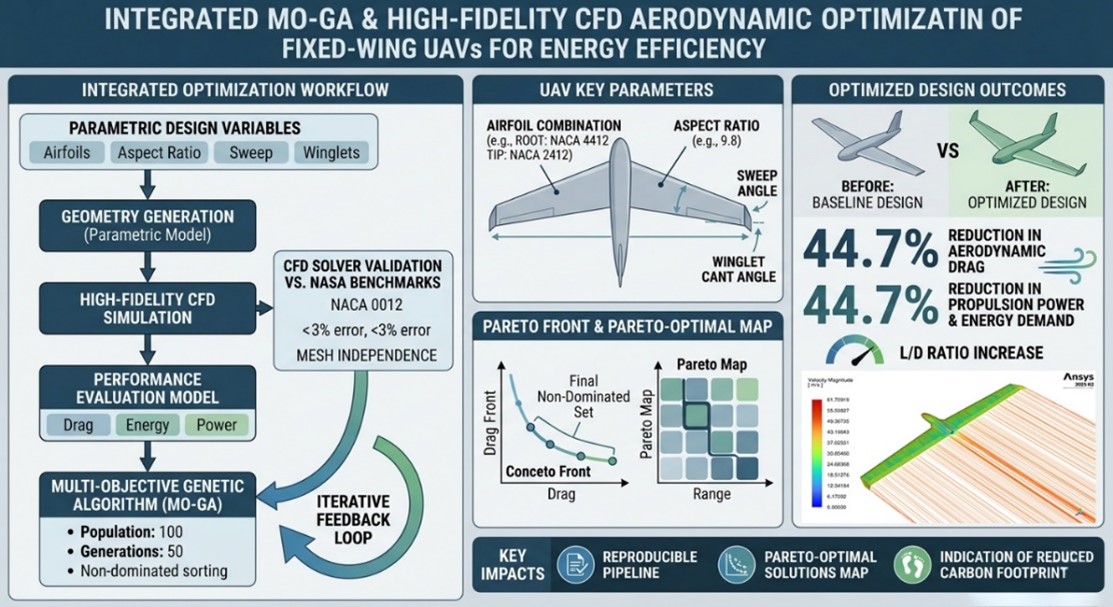
This study develops an integrated aerodynamic optimization and simulation pipeline for fixed‑wing Unmanned Aerial Vehicle (UAV) to improve mission efficiency while projecting lower carbon emissions through energy use reductions. A parametric geometry with airfoil selection, aspect ratio, sweep, taper, twist, and winglet controls is optimized using a multi‑objective genetic algorithm coupled to Computational Fluid Dynamics (CFD) simulation. Objectives minimize drag and mission power while maximizing lift‑to‑drag under representative cruise conditions. A data‑efficient power model links aerodynamic states to per‑mission energy, enabling rapid iteration as a surrogate within the optimization loop. To ensure reliability, the CFD solver was validated against NASA experimental benchmarks for the NACA 0012 airfoil, achieving a margin of error below 3%. The optimization results demonstrate a significant shift from traditional baseline designs. By adopting a non-symmetric air foil combination, NACA 4412 root and NACA 2412 tip, increasing the aspect ratio to 9.8, and implementing specific winglet cant angels, the optimized design achieved a 44.7% reduction in aerodynamic drag. Visual analysis through velocity and pressure contours confirmed cleaner flow fields and weakened wingtip vortices, which directly translate to lower propulsion power. Ultimately, this study delivers a reproducible design pipeline an a Pareto-optimal map for balancing aerodynamic efficiency with structural practicality. While emissions were not measured directly, the documented 44.7% reduction in drag and corresponding decrease in energy demand provide a strong indicator for the potential to lower the carbon footprint of future UAV operations.
##plugins.generic.usageStats.downloads##
Referensi
D. Bao, Y. Yan, Y. Li, and J. Chu, “The Future of Last-Mile Delivery: Lifecycle Environmental and Economic Impacts of Drone-Truck Parallel Systems,” Drones, vol. 9, no. 1, 2025, doi: 10.3390/drones9010054.
V. Garg, S. Niranjan, V. Prybutok, T. Pohlen, and D. Gligor, “Drones in last-mile delivery: A systematic review on Efficiency, Accessibility, and Sustainability,” 2023. doi: 10.1016/j.trd.2023.103831.
A. Raghunatha, E. Lindkvist, P. Thollander, E. Hansson, and G. Jonsson, “Critical assessment of emissions, costs, and time for last-mile goods delivery by drones versus trucks,” 2023. doi: 10.1038/s41598-023-38922-z.
M. Jacewicz, M. Żugaj, R. Głębocki, and P. Bibik, “Quadrotor Model for Energy Consumption Analysis,” Energies, vol. 15, no. 19, 2022, doi: 10.3390/en15197136.
T. Guo, C. Zhu, L. Feng, Y. Duan, And H. Chen, “Aerodynamic-driven morphing aircraft and its aerodynamic design,” Chinese J. Aeronaut., vol. 38, no. 6, p. 103377, 2025, doi: 10.1016/j.cja.2024.103377.
X. Du, P. He, and J. R. R. A. Martins, “Rapid airfoil design optimization via neural networks-based parameterization and surrogate modeling,” Aerosp. Sci. Technol., vol. 113, p. 106701, 2021, doi: 10.1016/j.ast.2021.106701.
“Aerodynamic or control integrated optimization method for unpowered high-speed vehicle configuration design.pdf.”
X. Li, K. Sun, And F. Li, “General optimal design of solar-powered unmanned aerial vehicle for priority considering propulsion system,” Chinese J. Aeronaut., vol. 33, no. 8, pp. 2176–2188, 2020, doi: 10.1016/j.cja.2020.04.009.
H. Nie, W. Song, Z. Han, And K. Zheng, “Attenuation of boundary-layer instabilities for natural laminar flow design on supersonic highly swept wings,” 2024. doi: 10.1016/j.cja.2024.06.037.
M. H. Negahban, M. Bashir, V. Traisnel, And R. M. Botez, “Seamless morphing trailing edge flaps for UAS-S45 using high-fidelity aerodynamic optimization,” 2024. doi: 10.1016/j.cja.2023.10.024.
W. Wang, W. An, And B. Song, “Effect of wing morphing on stability and energy harvesting in albatross dynamic soaring,” 2024. doi: 10.1016/j.cja.2024.06.013.
U. Ali, M. Okasha, T. N. Dief, M. S. A. ElSayed, and M. M. Kamra, “Blended wing body designs for aerodynamic, stability, and control optimization: A comprehensive review,” Transp. Eng., vol. 22, no. March, p. 100397, 2025, doi: 10.1016/j.treng.2025.100397.
Y. Chen, H. Rao, N. Xiong, J. Fan, Y. Shi, and T. Yang, “Adjoint-based robust optimization design of laminar flow airfoil under flight condition uncertainties,” 2023. doi: 10.1016/j.ast.2023.108465.
B. D. Phillips, J. Schmidt, R. D. Falck, and E. D. Aretskin-Hariton, “End-to-End Uncertainty Quantification with Analytical Derivatives for Design Under Uncertainty,” J. Aircr., vol. 62, no. 6, pp. 1–9, 2025, doi: 10.2514/1.c037976.
M. Muhammed, D. Harvey, H. A. Khawaja, M. S. Virk, and G. Momen, “In-cloud ice accretion and performance degradation of UAV propellers in forward flight: An experimental study,” Cold Reg. Sci. Technol., vol. 239, no. April, p. 104599, 2025, doi: 10.1016/j.coldregions.2025.104599.
Q. WANG, Z. GUO, L. SONG, and T. LIU, “A panoramic aerodynamic performance prediction method for turbomachinery cascades using transformer-enhanced neural operator,” Chinese J. Aeronaut., vol. 38, no. 7, p. 103473, 2025, doi: 10.1016/j.cja.2025.103473.
C. Li and X. Qiang, “Advancing reliability and efficiency of urban communication: Unmanned aerial vehicles, intelligent reflection surfaces, and deep learning techniques,” Heliyon, vol. 10, no. 11, p. e32472, 2024, doi: 10.1016/j.heliyon.2024.e32472.
M. B. Sushma, B. Mashhoodi, W. Tan, K. Liujiang, and Q. Xu, “Spatial drone path planning: A systematic review of parameters and algorithms,” J. Transp. Geogr., vol. 125, no. July 2024, p. 104209, 2025, doi: 10.1016/j.jtrangeo.2025.104209.
P. P. C. Brito, P. Morra, A. V. G. Cavalieri, T. B. Araújo, D. S. Henningson, and A. Hanifi, “Experimental control of Tollmien–Schlichting waves using pressure sensors and plasma actuators,” Exp. Fluids, vol. 62, no. 2, pp. 1–13, 2021, doi: 10.1007/s00348-020-03112-4.
S. Karpuk and V. Mosca, “Investigation of Hybrid Laminar Flow Control Capabilities from the Flight Envelope Perspective,” J. Aircr., vol. 61, no. 6, pp. 1629–1654, 2024, doi: 10.2514/1.C037744.
J. Najmi, H. A. Khan, S. S. Javaid, A. Hameed, and F. Siddiqui, “Aeroelastic tailoring for aerospace applications,” Heliyon, vol. 10, no. 2, p. e24151, 2024, doi: 10.1016/j.heliyon.2024.e24151.
T. Lin, R. Pecora, D. Ciliberti, W. Xia, And S. Hu, “Aerodynamic optimization of an adaptive flap for next-generation green aircraft,” 2024. doi: 10.1016/j.cja.2023.10.010.
A. Mosavi, “Multiobjective Optimization of Spline Curves using mode FRONTIER,” … Int. Conf. Eng. Optim. …, 2010, [Online]. Available: http://scholar.google.com/scholar?cluster=18435270614831105049&hl=en&oi=scholarr#0
Z. Chen, X. H. Wei, T. Xiao, and N. Qin, “Optimization of transonic low-Reynolds number airfoil based on genetic algorithm,” 2024. doi: 10.1177/09544100231207558.
S. Hao, T. Ma, S. Chen, H. Ma, J. Xiang, and F. Ouyang, “Static aeroelasticity of the propulsion system of ion propulsion unmanned aerial vehicles,” Propuls. Power Res., vol. 12, no. 3, pp. 336–355, 2023, doi: 10.1016/j.jppr.2023.01.001.
N. Kay and P. Richards, “Comparing the upper- and lower-surfaces of a NACA0012 in turbulence at low Reynolds numbers,” 2025. doi: 10.1016/j.ast.2025.110578.
B. Y. Kassa, A. T. Baheta, and A. Beyene, “Aerodynamic performance characteristics of low Re airfoils: A parametric and multi criteria decision study,” 2024. doi: 10.1016/j.rineng.2024.103174.
I. P. Wall, M. R. Amoozgar, and A. A. Popov, “Effect of Nonlinear Energy Sink on Aeroelasticity of High Aspect Ratio Wings,” Proc. ASME 2025 Aerosp. Struct. Struct. Dyn. Mater. Conf. SSDM 2025, p. 111439, 2025, doi: 10.1115/SSDM2025-152407.
M. Kazim et al., “Unmanned aircraft systems for precipitation enhancement: Advancements, challenges, and future prospects,” Atmos. Res., vol. 327, no. June 2025, p. 108333, 2026, doi: 10.1016/j.atmosres.2025.108333.
H. CHEN, X. WANG, L. SHEN, and Y. CONG, “Formation flight of fixed-wing UAV swarms: A group-based hierarchical approach,” Chinese J. Aeronaut., vol. 34, no. 2, pp. 504–515, 2021, doi: 10.1016/j.cja.2020.03.006.
C. HE, F. ZHAN, L. MA, G. CHEN, and J. MA, “Aero-structural design of joined-wing aircraft based on high-fidelity model,” 2024. doi: 10.1016/j.cja.2023.10.029.
G. M. J. Alam and M. Mamun, “Aerodynamic Characteristics of Aerofoil Shaped Fuselage UAV Model and Compare with the Conventional Model Using CFD Software,” AIP Conf. Proc., vol. 2324, 2021, doi: 10.1063/5.0037494.
A. D. Gardner, A. R. Jones, K. Mulleners, J. W. Naughton, and M. J. Smith, “Review of rotating wing dynamic stall: Experiments and flow control,” 2023. doi: 10.1016/j.paerosci.2023.100887.
K. L. Tomek, A. H. Ullah, C. Fabijanic, and J. Estevadeordal, “Experimental investigation of dynamic stall on pitching swept finite-aspect-ratio wings,” AIAA Scitech 2020 Forum, vol. 1 PartF, no. January, pp. 1–35, 2020, doi: 10.2514/6.2020-1980.
H. H. Samputh, L. K. Moey, V. C. Tai, and Y. C. Tan, “Investigation of Aerodynamic Characteristics of Swept C-Wing Configurations At Transonic Speed Using Design of Experiments and Computational Fluid Dynamics,” Aviation, vol. 28, no. 2, pp. 72–84, 2024, doi: 10.3846/aviation.2024.21495.
M. H. Farook and V. Kumar G. C., “Numerical Investigation of Blended and Raked Winglets Characteristics,” 2024. doi: 10.37394/232030.2024.3.3.
M. Arafat, I. A. Ishak, and N. Mohd Maruai, “Assessment of computational fluid dynamics simulation approach for the aerodynamic performance of small unmanned aerial vehicle propeller,” 2024. doi: 10.1088/2631-8695/ad9e6c.
J. M. Oendo and N. A. A. Qasem, “Aerodynamic analysis of RQ-2 fixed-wing UAVs in close formation flight,” 2025. doi: 10.1016/j.trpro.2025.03.123.
A. Isah, M. S. Lawal, I. Yahuza, and A. Na’inna, “Modelling and Aerodynamic Performance of an Unmanned Aerial Vehicle Wing,” Niger. J. Technol. Dev., vol. 22, no. 4, pp. 15–24, 2025, doi: 10.63746/njtd.v22i4.3663.
S. Toosi, A. Peplinski, P. Schlatter, and R. Vinuesa, “The impact of finite span and wing-tip vortices on a turbulent NACA0012 wing,” J. Fluid Mech., vol. 997, pp. 1–33, 2024, doi: 10.1017/jfm.2024.667.
M. Zaccara et al., “Near field evolution of wingtip vortices under synthetic-jet based control,” Aerosp. Sci. Technol., vol. 148, no. June 2023, p. 109068, 2024, doi: 10.1016/j.ast.2024.109068.
A. Watanabe et al., “Effect of pressure sensor arrangement on deep reinforcement learning-based feedback control of separated flow around aerofoils,” Aerosp. Sci. Technol., vol. 164, 2025, doi: 10.1016/j.ast.2025.110347.
K. W. McAlister and R. K. Takahashi, “NACA 0012 Wing Pressure and Airfoil Data,” National Aeronautics and Space Administration (NASA), Ames Research Center, Moffett Field, California, 1991. [Online]. Available: https://ntrs.nasa.gov/citations/19920004077.
##submission.copyrightStatement##
##submission.license.cc.by-nc-sa4.footer##